Free and safe Shipping
| Size | Museum Quality Artworks Hand-Painted with oil paint |
|---|---|
| 23.6 x 23 in 60x59 cm |
$ 788.00 Add to Cart |
| 32 x 30 in 80x78 cm |
$ 875.00 Add to Cart
|
| 40 x 38 in 100cm x 98 cm |
$ 1236.00 Add to Cart |
| 4 x 3.8 ft or 47 ¼ x 46 in 120cm x 117 cm |
$ 1572.00 Add to Cart |
| 5 x 4.8 ft or 59 x 57 in 150cm x 147 cm |
$ 2160.00 Add to Cart |
| 6.6 x 6.4 ft or 78 ¾ x 77 in 200cm x 196 cm |
$ 3294.00 Add to Cart |
| 8.16 x 8.0 ft or 98 ½ x 96 in 250cm x 244 cm |
$ 4270.00 Add to Cart |
| 9.8 x 9.6 ft 300cm x 293 cm |
$ 6153.00 Add to Cart |
| 13.12 x 12.8 ft 400cm x 391 cm |
$ 10948.00 Add to Cart |
| 16.4 x 16.0 ft 500cm x 489 cm |
$ 17115.00 - 20% off $ 13692.00 Add to Cart |
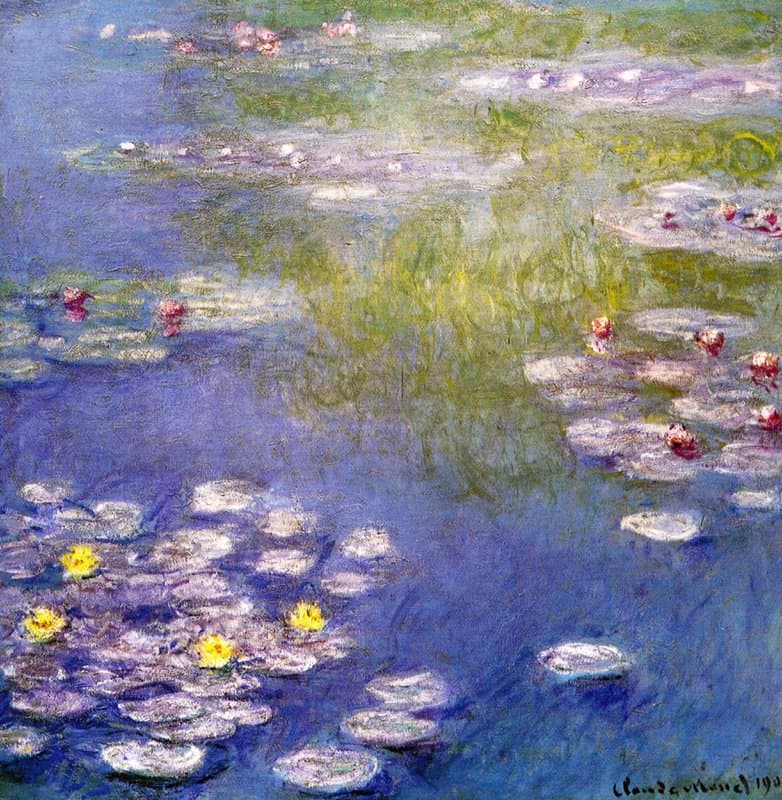
Museum-quality hand-painted artwork Claude Monet, Water Lilies (Nymphéas) -1903
Museum-quality replicas by Paolo: Exceptional product, accurate to the tiniest details, textures and values. Requires skills and time to process, but gives astonishing results. A true work of art for the real connoisseurs.
Buy Claude Monet, Water Lilies (Nymphéas) -1903 museum quality
Nymphéas (Water Lilies): Monet’s Infinite Reflection at Giverny
Claude Monet’s Nymphéas (1903) is a transformative work that redefined the landscape genre. In this series, Monet abandoned traditional perspective, removing the sky and the shore to focus exclusively on the water's surface. By painting the sky only as a reflection, he created an immersive, "limitless" composition that would eventually pave the way for modern abstract expressionism.
Artistic Analysis & Visual Style
-
The Floating World: The yellow and pink water lilies appear to drift across the canvas, anchored by the dark, vertical reflections of trees and reeds that exist outside the frame.
-
Palette of Light: Monet uses a sophisticated blend of cobalt blues, deep violets, and emerald greens to represent the depth of the pond, while the surface is punctuated by bright, high-contrast yellows and whites.
-
Liquid Perspective: Without a horizon line, the viewer loses their sense of "up" and "down," creating a meditative, ethereal experience often referred to as "shattered" or "fluid" space.
-
Textural Layering: Monet applied layers of paint over time to create a dense, crust-like texture (impasto) that mimics the organic complexity of the pond's ecosystem.
Historical Significance: The Giverny Sanctuary
By 1903, Monet’s water garden in Giverny had become his sole obsession. He spent hours observing the minute changes in the water as the sun moved across the sky. This specific 1903 series was part of his preparation for the massive "Grandes Décorations" permanent murals now housed in the Musée de l'Orangerie. Specifically, this 1903 work is from the period where he began to remove the horizon line entirely, focusing solely on the reflective surface of the water.