Free and safe Shipping
| Size | Museum Quality Artworks Hand-Painted with oil paint |
|---|---|
| 23.6 x 16 in 60x43 cm |
$ 574.00 Add to Cart |
| 32 x 22 in 80x57 cm |
$ 637.00 Add to Cart
|
| 40 x 27 in 100cm x 71 cm |
$ 896.00 Add to Cart |
| 4 x 2.8 ft or 47 ¼ x 33 in 120cm x 86 cm |
$ 1155.00 Add to Cart |
| 5 x 3.5 ft or 59 x 42 in 150cm x 107 cm |
$ 1572.00 Add to Cart |
| 6.6 x 4.7 ft or 78 ¾ x 56 in 200cm x 143 cm |
$ 2401.00 Add to Cart |
| 8.16 x 5.8 ft or 98 ½ x 70 in 250cm x 178 cm |
$ 3115.00 Add to Cart |
| 9.8 x 7.0 ft 300cm x 214 cm |
$ 4494.00 Add to Cart |
| 13.12 x 9.4 ft 400cm x 286 cm |
$ 8008.00 Add to Cart |
| 16.4 x 11.7 ft 500cm x 357 cm |
$ 12495.00 - 20% off $ 9996.00 Add to Cart |
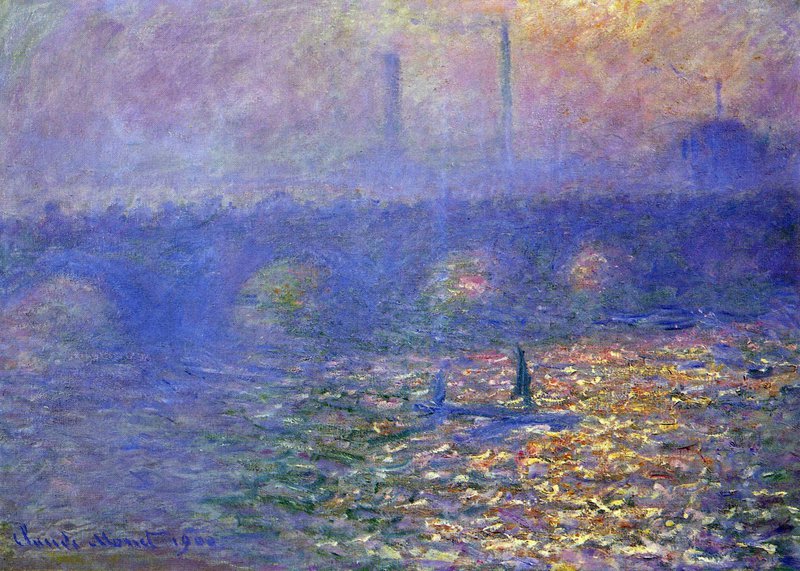
Museum-quality hand-painted artwork Claude Monet, Waterloo Bridge, Gray Day
Museum-quality replicas by Paolo: Exceptional product, accurate to the tiniest details, textures and values. Requires skills and time to process, but gives astonishing results. A true work of art for the real connoisseurs.
Buy Claude Monet, Waterloo Bridge, Gray Day museum quality
This atmospheric masterpiece is "Waterloo Bridge, Gray Day" (or Waterloo Bridge, le temps gris), painted in 1900. It belongs to Monet’s legendary London series, where he famously obsessed over the "London fog" and how it transformed the industrial city into a dreamlike landscape.
Waterloo Bridge: Monet’s Impressionist Vision of the London Fog
Claude Monet’s Waterloo Bridge (1900) is a quintessential example of his London series. Painted from his balcony at the Savoy Hotel, this work captures the iconic bridge as it dissolves into the thick, smoky mist of the Thames. For Monet, London wasn't about architecture; it was about the "envelope"—the unique way the city's coal-heavy fog caught the light, creating a hazy, ethereal beauty out of industrial grit.
Artistic Analysis & Visual Style
-
The "Envelope" of Fog: Monet famously said, "Without the fog, London wouldn't be a beautiful city." In this work, the bridge is nearly a silhouette, its arches appearing and disappearing through layers of lavender, violet, and soft blue mist.
-
Sunlight on the Thames: The focal point is the path of light reflecting on the water. Monet uses short, staccato dabs of golden yellow and pale pink to represent the sun’s struggle to break through the overcast sky.
-
Industrial Silhouettes: In the background, the smoking chimneys of the South Bank represent the modern, industrial reality of 1900 London, transformed here into poetic, vertical dabs of dark blue.
-
Subtle Color Theory: Despite the "gray day" title, the painting is filled with color. Monet uses complementary violets and yellows to create a visual vibration that makes the misty air feel dense and humid.
Historical Significance: The London Series
Monet visited London three times between 1899 and 1901. During these trips, he painted nearly 100 views of the Thames, including the Houses of Parliament and Charing Cross Bridge. This series is celebrated as a major step toward Modernism, as Monet moved further away from representational detail and toward a pure, optical experience of light and air.