Free and safe Shipping
| Size | Museum Quality Artworks Hand-Painted with oil paint |
|---|---|
| 23.6 x 18 in 60x47 cm |
$ 637.00 Add to Cart |
| 32 x 24 in 80x63 cm |
$ 707.00 Add to Cart
|
| 40 x 31 in 100cm x 79 cm |
$ 994.00 Add to Cart |
| 4 x 3.1 ft or 47 ¼ x 37 in 120cm x 94 cm |
$ 1264.00 Add to Cart |
| 5 x 3.9 ft or 59 x 46 in 150cm x 118 cm |
$ 1736.00 Add to Cart |
| 6.6 x 5.2 ft or 78 ¾ x 61 in 200cm x 157 cm |
$ 2639.00 Add to Cart |
| 8.16 x 6.5 ft or 98 ½ x 77 in 250cm x 197 cm |
$ 3448.00 Add to Cart |
| 9.8 x 7.7 ft 300cm x 236 cm |
$ 4956.00 Add to Cart |
| 13.12 x 10.3 ft 400cm x 315 cm |
$ 8820.00 Add to Cart |
| 16.4 x 12.9 ft 500cm x 394 cm |
$ 13790.00 - 20% off $ 11032.00 Add to Cart |
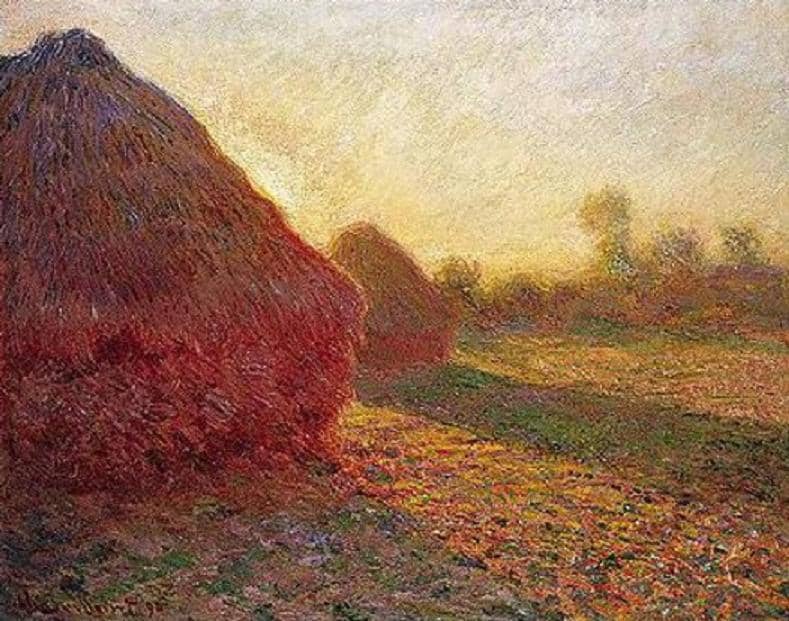
Museum-quality hand-painted artwork Claude Monet, Grainstacks, Last Rays of the Sun
Museum-quality replicas by Paolo: Exceptional product, accurate to the tiniest details, textures and values. Requires skills and time to process, but gives astonishing results. A true work of art for the real connoisseurs.
Buy Claude Monet, Grainstacks, Last Rays of the Sun museum quality
Grainstacks, Last Rays of the Sun: Monet’s Radiant Evening Finale
Claude Monet’s Meules, derniers rayons du soleil (1890–1891) is a profound exploration of the transition between day and night. In this work, the grainstacks near Monet’s home in Giverny act as light-catchers, absorbing the final, intense warmth of the sun. It is a masterpiece that prioritizes "sensation over perception," where the subject matter (the stacks) nearly dissolves into a sea of pure, vibrating color.
Artistic Analysis & Visual Style
-
Chromatic "F hearth fires": The shadow side of the primary stack is rendered in deep rusts and dark reds, while the light-struck edge glows with an almost neon orange. This represents the "golden hour" at its most extreme.
-
The Atmospheric Envelope: Monet was fascinated by how the air itself changed color at dusk. The sky isn't just a backdrop; it’s a hazy mix of pale yellows and soft mauves that unify the entire landscape.
-
Textural Impasto: The paint is applied with thick, rapid dabs. This creates a rough, tactile surface that mimics the dry straw of the stacks and the uneven ground of the field, catching physical light in the gallery much like the stacks caught the sun in Giverny.
-
Distant Depth: A second stack sits further back, partially veiled by the evening haze, providing a sense of scale and the quiet stillness of the French countryside at dusk.
The Serial Significance
This painting was part of the 1891 exhibition at the Durand-Ruel gallery, where Monet insisted that the Haystacks be shown together. He believed that the true value of the works was found in their succession—showing how one "moment" of light transformed into the next.
Fast Facts for Art Lovers
-
The Title: Meules is often translated as "Haystacks," but they are actually grainstacks (wheat or barley) that were built with thatched roofs to protect the harvest.
-
Location: While many in this series are in the Art Institute of Chicago or Musée d'Orsay, several versions of the evening "Last Rays" are held in prestigious private collections or have been auctioned for record-breaking sums.
-
Technique: Painted alla prima (wet-on-wet) in short bursts. Monet would famously switch canvases every few minutes as the sun dipped lower, racing to catch the fleeting light.
-
Influence: This series is noted as the bridge between Impressionism and Abstract Expressionism, as it showed that color could be the "main character" of a painting.