Free and safe Shipping
| Size | Museum Quality Artworks Hand-Painted with oil paint |
|---|---|
| 23.6 x 16 in 60x41 cm |
$ 431.00 Add to Cart |
| 32 x 21 in 80x55 cm |
$ 616.00 Add to Cart
|
| 40 x 26 in 100cm x 68 cm |
$ 858.00 Add to Cart |
| 4 x 2.7 ft or 47 ¼ x 32 in 120cm x 82 cm |
$ 1103.00 Add to Cart |
| 5 x 3.4 ft or 59 x 40 in 150cm x 103 cm |
$ 1516.00 Add to Cart |
| 6.6 x 4.5 ft or 78 ¾ x 53 in 200cm x 137 cm |
$ 2303.00 Add to Cart |
| 8.16 x 5.6 ft or 98 ½ x 67 in 250cm x 171 cm |
$ 2993.00 Add to Cart |
| 9.8 x 6.7 ft 300cm x 205 cm |
$ 4305.00 Add to Cart |
| 13.12 x 9.0 ft 400cm x 274 cm |
$ 7672.00 Add to Cart |
| 16.4 x 11.2 ft 500cm x 342 cm |
$ 11970.00 - 20% off $ 9576.00 Add to Cart |
Original Size or Requested size museum grade
4.3 x 2.9 ft or 130 x 89 cm
$ 1295.00 Add to Cart
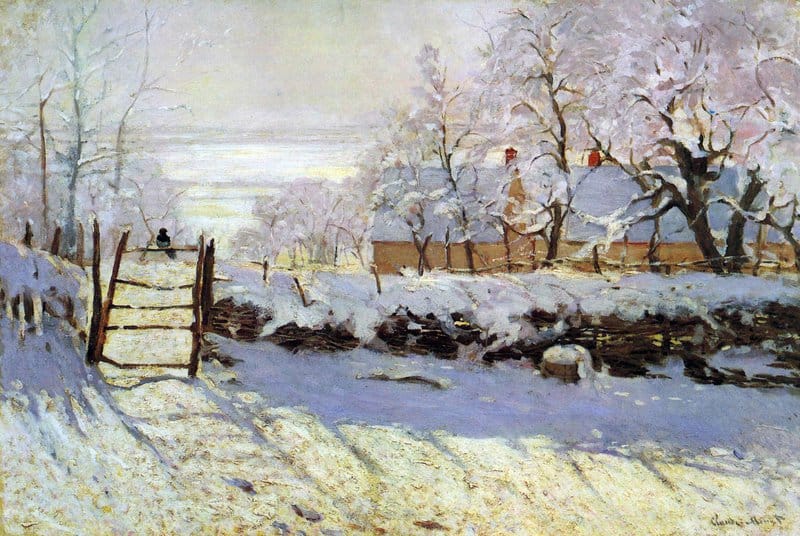
Museum-quality hand-painted artwork Claude Monet, The Magpie
Museum-quality replicas by Paolo: Exceptional product, accurate to the tiniest details, textures and values. Requires skills and time to process, but gives astonishing results. A true work of art for the real connoisseurs.
Buy Claude Monet, The Magpie museum quality
The Magpie: Monet’s Masterpiece of Winter Light and Blue Shadows
Claude Monet’s The Magpie is a serene, atmospheric capture of a snowy day near Étretat in Normandy. While winter landscapes were common at the time, Monet’s approach was radical: he proved that snow isn't just white, but a canvas reflecting a spectrum of golds, violets, and—most famously—cool blues.
Artistic Analysis & Visual Style
-
The Blue Shadows: This painting is the most cited example of Monet’s discovery of colored shadows. Rather than using black or grey, he used brilliant blues and purples to depict shadows on the snow, capturing the reality of how light refracts in winter.
-
The Lone Magpie: A tiny, dark magpie perches on a wattle fence (a gate), acting as a single note of punctuation in an otherwise vast, silent landscape. It creates a sense of profound stillness and "living" presence.
-
Saturated Light: The low winter sun creates long, rhythmic shadows that stretch across the foreground, leading the viewer’s eye toward the thatched-roof buildings in the background.
-
Impressionist Texture: The snow is painted with a thick, creamy application, suggesting the heavy, insulating blanket of a fresh snowfall.
Historical Significance: Rejected by the Salon
When Monet submitted The Magpie to the Paris Salon of 1869, it was rejected. Critics at the time found the colors too bright and the brushwork too "sketchy." Today, it is celebrated as a foundational work of Impressionism, proving that Monet was years ahead of his contemporaries in understanding optical science and natural light.
-
Location: The original painting is a center-piece at the Musée d'Orsay in Paris.
-
The Setting: Painted en plein air near Étretat, a coastal town in Normandy where Monet spent many winters.
-
Technique: This is Monet's largest winter landscape, measuring approximately .
-
The "Atmosphere": The painting is famous for its "silence"—the visual equivalent of the muffled sound that only occurs after a heavy snowfall.