Free and safe Shipping
| Size | Museum Quality Artworks Hand-Painted with oil paint |
|---|---|
| 23.6 x 18 in 60x46 cm |
$ 616.00 Add to Cart |
| 32 x 24 in 80x61 cm |
$ 683.00 Add to Cart
|
| 40 x 29 in 100cm x 76 cm |
$ 959.00 Add to Cart |
| 4 x 3.0 ft or 47 ¼ x 35 in 120cm x 91 cm |
$ 1222.00 Add to Cart |
| 5 x 3.7 ft or 59 x 44 in 150cm x 114 cm |
$ 1677.00 Add to Cart |
| 6.6 x 5.0 ft or 78 ¾ x 59 in 200cm x 152 cm |
$ 2555.00 Add to Cart |
| 8.16 x 6.2 ft or 98 ½ x 74 in 250cm x 190 cm |
$ 3325.00 Add to Cart |
| 9.8 x 7.5 ft 300cm x 228 cm |
$ 4788.00 Add to Cart |
| 13.12 x 10.0 ft 400cm x 305 cm |
$ 8540.00 Add to Cart |
| 16.4 x 12.5 ft 500cm x 381 cm |
$ 13335.00 - 20% off $ 10668.00 Add to Cart |
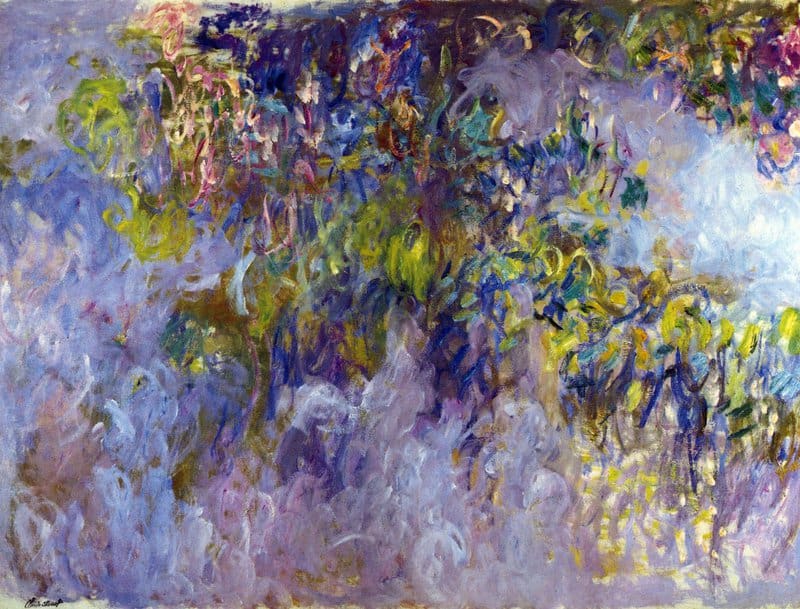
Museum-quality hand-painted artwork Claude Monet, Wisteria (Les Glycines)
Museum-quality replicas by Paolo: Exceptional product, accurate to the tiniest details, textures and values. Requires skills and time to process, but gives astonishing results. A true work of art for the real connoisseurs.
Buy Claude Monet, Wisteria (Les Glycines) museum quality
This stunning work is "Wisteria" (Les Glycines), painted between 1919 and 1920. It belongs to the very end of Claude Monet’s life and is one of his most experimental, nearly abstract compositions.
Wisteria (1919–1920): Monet’s Abstract Floral Finale
Claude Monet’s Wisteria is a monumental achievement of his final years. Painted during the same period as his massive Water Lilies murals, this work captures the cascading vines of the wisteria that draped over his famous Japanese bridge at Giverny. By this stage, Monet’s cataracts and his desire for total immersion led him to dissolve form entirely, leaving behind a swirling "symphony" of purple and green.
Artistic Analysis & Visual Style
-
Cascading Abstraction: The composition is defined by the downward, rhythmic flow of the wisteria blossoms. There is no sky, no ground, and no bridge—only the sensory experience of being enveloped by the hanging flowers.
-
Jewel-Toned Palette: Monet utilizes a vibrant, high-energy range of lavenders, deep purples, and magentas, punctuated by flashes of bright chartreuse and emerald green.
-
Gestural Brushwork: The brushstrokes are long, loopy, and highly expressive. This "sketchy" quality was revolutionary, as it prioritized the artist’s emotional energy over the physical reality of the plant.
-
Atmospheric Light: The pale blue and white patches in the background represent light filtering through the vines, giving the painting a translucent, airy quality despite the heavy application of paint.
Historical Significance: The "Grandes Décorations"
Monet originally intended for his Wisteria paintings to hang as a frieze above his Water Lilies murals in the Musée de l'Orangerie. He saw them as a way to "close" the cycle of nature. While they weren't included in the final installation, these works are now seen as a bridge between 19th-century Impressionism and 20th-century Abstract Expressionism.