Free and safe Shipping
| Size | Museum Quality Artworks Hand-Painted with oil paint |
|---|---|
| 23.6 x 16 in 60x43 cm |
$ 574.00 Add to Cart |
| 32 x 22 in 80x57 cm |
$ 637.00 Add to Cart
|
| 40 x 27 in 100cm x 71 cm |
$ 896.00 Add to Cart |
| 4 x 2.8 ft or 47 ¼ x 33 in 120cm x 86 cm |
$ 1155.00 Add to Cart |
| 5 x 3.5 ft or 59 x 42 in 150cm x 107 cm |
$ 1572.00 Add to Cart |
| 6.6 x 4.7 ft or 78 ¾ x 56 in 200cm x 143 cm |
$ 2401.00 Add to Cart |
| 8.16 x 5.8 ft or 98 ½ x 70 in 250cm x 178 cm |
$ 3115.00 Add to Cart |
| 9.8 x 7.0 ft 300cm x 214 cm |
$ 4494.00 Add to Cart |
| 13.12 x 9.4 ft 400cm x 285 cm |
$ 7980.00 Add to Cart |
| 16.4 x 11.7 ft 500cm x 357 cm |
$ 12495.00 - 20% off $ 9996.00 Add to Cart |
Original Size or Requested size museum grade
3 x 2.2 ft or 92 x 65.6 cm
$ 844.00 Add to Cart
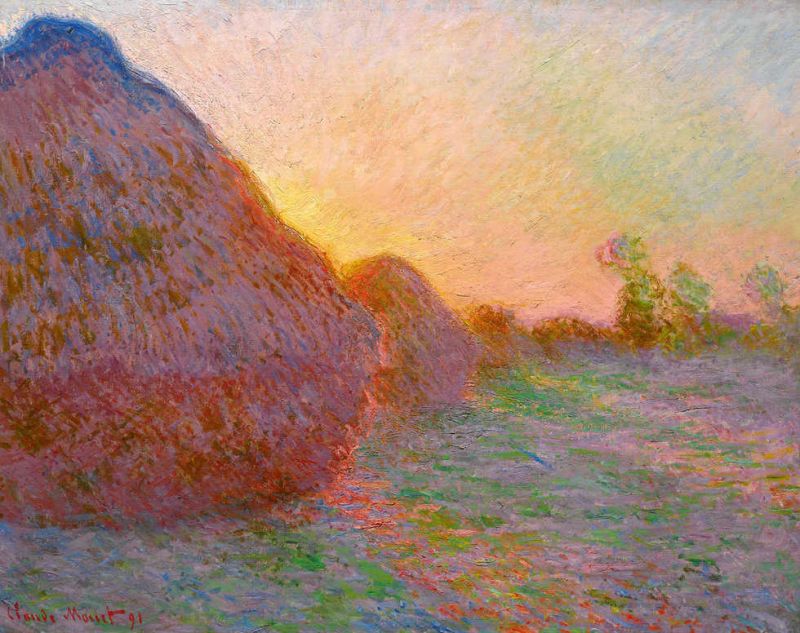
Museum-quality hand-painted artwork Claude Monet, Haystacks, (Midday) - 1891
Museum-quality replicas by Paolo: Exceptional product, accurate to the tiniest details, textures and values. Requires skills and time to process, but gives astonishing results. A true work of art for the real connoisseurs.
Buy Claude Monet, Haystacks, (Midday) - 1891 museum quality
Meules (1891): Monet’s Masterclass in Midday Light
Claude Monet’s Meules (1891) is a standout piece from his revolutionary Haystacks series. While many paintings in this collection explore the soft hues of dawn or the fiery reds of sunset, this specific work captures the shimmering, bleached-out intensity of the midday sun. It is a testament to Monet's ability to paint not just the objects themselves, but the very air and light that exists between the artist and his subject.
Artistic Analysis & Visual Style
-
Luminous Color Palette: Unlike the deep violets of his evening scenes, this painting utilizes pale yellows, baby blues, and soft pinks. The highlights on the stacks are so bright they nearly dissolve the solid form of the hay.
-
Shadow Play: Notice the long, cool-toned shadows stretching across the foreground. Monet famously avoided using black, instead creating shadows through a mix of cobalt blue, emerald green, and deep purple.
-
Flickering Brushwork: The sky and the field are rendered with short, multidirectional strokes. This creates a "vibrating" effect that mimics the way heat haze appears on a hot summer day in the French countryside.
-
Compositional Balance: The placement of a large stack in the foreground and a smaller one in the distance provides a sense of scale and depth, anchoring the viewer in the vast, open fields of Giverny.
The "Series" Philosophy
By painting these stacks over and over, Monet proved a radical point: the subject is secondary to the light. In this midday version, the stacks are almost secondary to the overwhelming brightness of the sky, demonstrating that "the motif is an insignificant factor; what I want to reproduce is what lies between the motif and me."
BTW, that is my favorite Monet painting, from far.
Fast Facts for Art Historians
-
Collection: This specific version is housed in the Art Institute of Chicago, which holds one of the largest collections of Monet’s Haystacks in the world.
-
The "Grain" Truth: Although often called "Haystacks," these were actually wheat stacks (grainstacks), which were much larger and more structurally sound, allowing Monet weeks to paint them before they were processed.
-
Symbolism: For many of Monet’s contemporaries, these stacks represented the prosperity and fertility of the French landscape following the Franco-Prussian War.
-
Dimensions: Approximately .