Free and safe Shipping
| Size | Museum Quality Artworks Hand-Painted with oil paint |
|---|---|
| 23.6 x 23 in 60x60 cm |
$ 805.00 Add to Cart |
| 32 x 31 in 80x80 cm |
$ 896.00 Add to Cart
|
| 40 x 38 in 100cm x 99 cm |
$ 1246.00 Add to Cart |
| 4 x 3.9 ft or 47 ¼ x 46 in 120cm x 119 cm |
$ 1600.00 Add to Cart |
| 5 x 4.9 ft or 59 x 58 in 150cm x 149 cm |
$ 2191.00 Add to Cart |
| 6.6 x 6.5 ft or 78 ¾ x 78 in 200cm x 199 cm |
$ 3343.00 Add to Cart |
| 8.16 x 8.1 ft or 98 ½ x 97 in 250cm x 248 cm |
$ 4340.00 Add to Cart |
| 9.8 x 9.8 ft 300cm x 298 cm |
$ 6258.00 Add to Cart |
| 13.12 x 13.1 ft 400cm x 398 cm |
$ 11144.00 Add to Cart |
| 16.4 x 16.3 ft 500cm x 497 cm |
$ 17395.00 - 20% off $ 13916.00 Add to Cart |
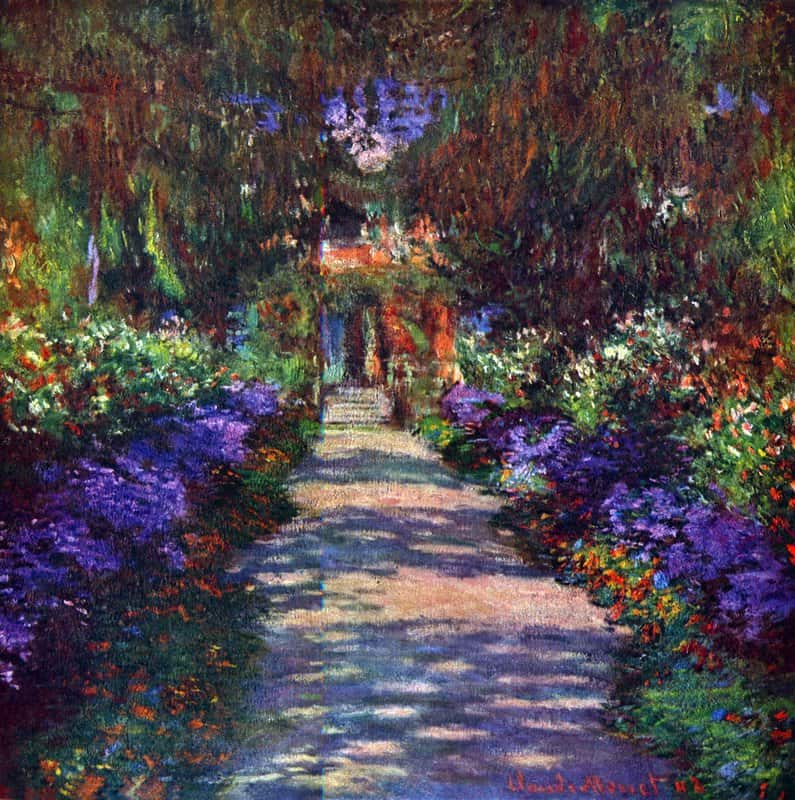
Museum-quality hand-painted artwork Claude Monet, The Garden Path at Giverny
Museum-quality replicas by Paolo: Exceptional product, accurate to the tiniest details, textures and values. Requires skills and time to process, but gives astonishing results. A true work of art for the real connoisseurs.
Buy Claude Monet, The Garden Path at Giverny museum quality
The Garden Path at Giverny: Monet’s Immersive Impressionist Walkway
Claude Monet’s The Garden Path at Giverny (1902) is a vibrant celebration of summer in the French countryside. This masterpiece focuses on the "Grande Allée," a central path in Monet’s garden at Giverny, lined with lush banks of purple irises and shaded by a dense, sun-dappled canopy of trees.
Unlike his earlier, more structured landscapes, this 1902 composition uses a vertical perspective to pull the viewer into the heart of the garden, creating a sensory experience of light, shadow, and floral scent.
Artistic Analysis & Visual Style
-
The "Tunnel" Effect: Monet uses the overhanging trees to create a natural archway, framing the garden path and drawing the eye toward the steps of his house in the background.
-
Mastery of Purple & Blue: The painting is famous for its use of deep violets and cool lavenders in the iris beds, which are balanced by the warm, earthy tones of the sun-drenched path.
-
Dappled Sunlight: The path itself is a canvas of light; Monet uses broken brushstrokes of white, blue, and gold to represent the flickering sunlight breaking through the leaves above.
-
Textural Brushwork: In this later period, Monet’s strokes became thicker and more expressive (impasto), giving the flowers a tactile, three-dimensional quality.
Historical Context: The Giverny Years
By 1902, Monet had completely transformed his property into a living artwork. He designed the garden specifically to be painted, coordinating the bloom cycles so he would always have a "motif" ready. This painting captures the garden at the height of its maturity, just before he began his final, exclusive focus on the water lily pond.