Free and safe Shipping
| Size | Museum Quality Artworks Hand-Painted with oil paint |
|---|---|
| 23.6 x 16 in 60x42 cm |
$ 564.00 Add to Cart |
| 32 x 22 in 80x56 cm |
$ 627.00 Add to Cart
|
| 40 x 27 in 100cm x 70 cm |
$ 882.00 Add to Cart |
| 4 x 2.7 ft or 47 ¼ x 32 in 120cm x 83 cm |
$ 1117.00 Add to Cart |
| 5 x 3.4 ft or 59 x 40 in 150cm x 104 cm |
$ 1530.00 Add to Cart |
| 6.6 x 4.6 ft or 78 ¾ x 54 in 200cm x 139 cm |
$ 2335.00 Add to Cart |
| 8.16 x 5.7 ft or 98 ½ x 68 in 250cm x 174 cm |
$ 3045.00 Add to Cart |
| 9.8 x 6.9 ft 300cm x 209 cm |
$ 4389.00 Add to Cart |
| 13.12 x 9.1 ft 400cm x 278 cm |
$ 7784.00 Add to Cart |
| 16.4 x 11.4 ft 500cm x 348 cm |
$ 12180.00 - 20% off $ 9744.00 Add to Cart |
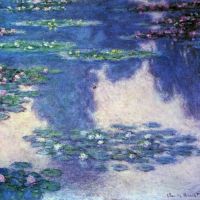
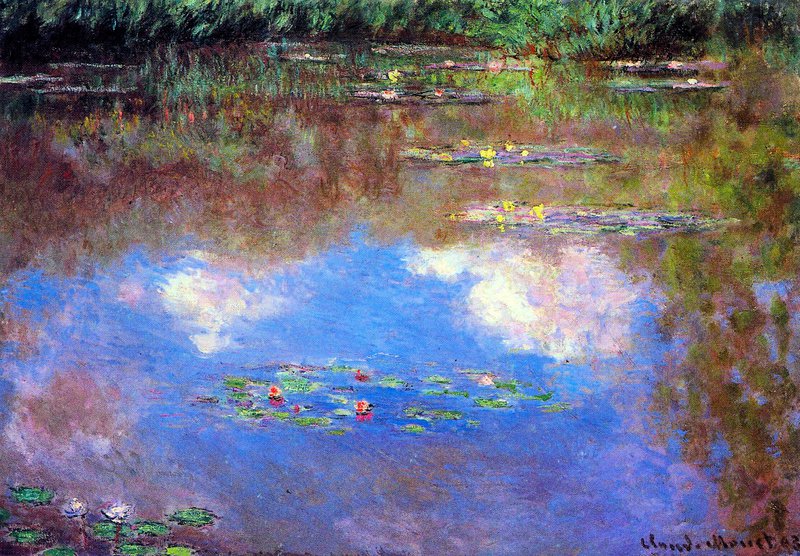
Museum-quality hand-painted artwork Claude Monet, Water Lilies (1903)
Museum-quality replicas by Paolo: Exceptional product, accurate to the tiniest details, textures and values. Requires skills and time to process, but gives astonishing results. A true work of art for the real connoisseurs.
Buy Claude Monet, Water Lilies (1903) museum quality
This specific masterpiece is "Water Lilies" (1903), part of the legendary Paysage d'eau (Water Landscapes) series. This work is a masterclass in the "mirror effect," where Monet captures the sky and clouds not by looking up, but by looking down into the soul of his Giverny pond.
Water Lilies (1903): Monet’s Mirror of the Heavens
Claude Monet’s Water Lilies (1903) is a transformative work of Late Impressionism. In this composition, Monet removes the shoreline and the horizon entirely, focusing exclusively on the water's surface. By painting the reflection of bright, white clouds against a deep cerulean blue, he creates a disorienting yet peaceful "liquid landscape" that bridges the gap between the earth and the sky.
Artistic Analysis & Visual Style
-
The Cloud Reflection: The central focal point is a brilliant reflection of summer clouds, rendered in soft whites and pale pinks. This "light from within the water" gives the painting an ethereal, glowing quality.
-
Warm vs. Cool Tones: Monet masterfully balances the cool indigoes and violets of the water with the warm ochres and deep russets of the surrounding bank’s reflections. This contrast creates a sense of late afternoon warmth.
-
Floating Islands: The water lilies are arranged in scattered horizontal clusters, providing the only structural anchor in an otherwise fluid space. Their tiny dabs of red and yellow act as jewels of light on the dark water.
-
Optical Immersion: By omitting any land-based reference points, Monet forces the viewer to lose their sense of traditional perspective, inviting a meditative state known as "immersion Impressionism."
Historical Significance: The Giverny Evolution
Between 1903 and 1908, Monet produced a cohesive group of 48 "Water Landscapes." This 1903 canvas represents the moment he moved away from the "Japanese Bridge" as a subject and became obsessed with the optical physics of water. It serves as a direct precursor to the massive murals currently housed in the Musée de l'Orangerie.