Free and safe Shipping
| Size | Museum Quality Artworks Hand-Painted with oil paint |
|---|---|
| 23.6 x 19 in 60x49 cm |
$ 515.00 Add to Cart |
| 32 x 25 in 80x65 cm |
$ 728.00 Add to Cart
|
| 40 x 32 in 100cm x 82 cm |
$ 1033.00 Add to Cart |
| 4 x 3.2 ft or 47 ¼ x 38 in 120cm x 98 cm |
$ 1316.00 Add to Cart |
| 5 x 4.0 ft or 59 x 48 in 150cm x 123 cm |
$ 1810.00 Add to Cart |
| 6.6 x 5.4 ft or 78 ¾ x 64 in 200cm x 164 cm |
$ 2755.00 Add to Cart |
| 8.16 x 6.7 ft or 98 ½ x 80 in 250cm x 204 cm |
$ 3570.00 Add to Cart |
| 9.8 x 8.0 ft 300cm x 245 cm |
$ 5145.00 Add to Cart |
| 13.12 x 10.7 ft 400cm x 327 cm |
$ 9156.00 Add to Cart |
| 16.4 x 13.4 ft 500cm x 409 cm |
$ 14315.00 - 20% off $ 11452.00 Add to Cart |
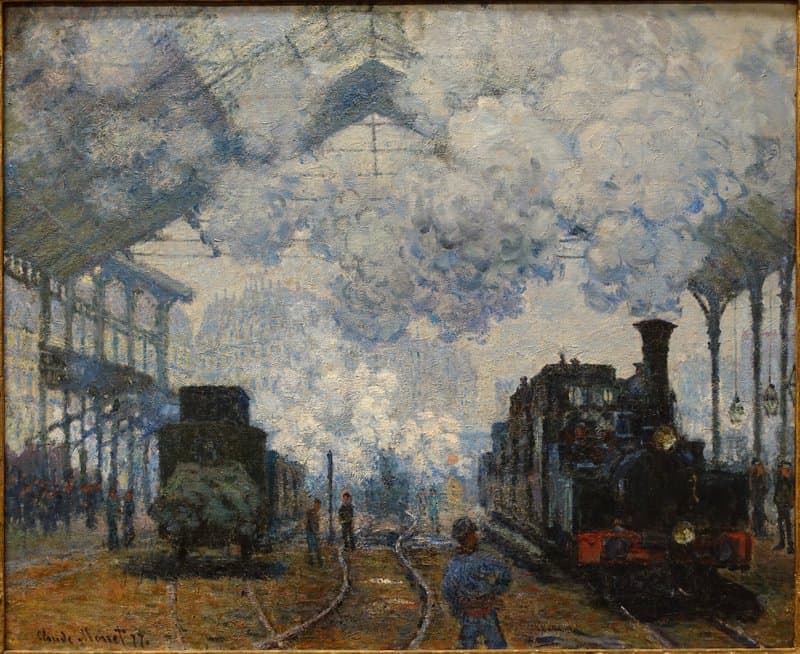
Museum-quality hand-painted artwork Claude Monet, The Gare Saint-lazare Arrival Of A Train
Museum-quality replicas by Paolo: Exceptional product, accurate to the tiniest details, textures and values. Requires skills and time to process, but gives astonishing results. A true work of art for the real connoisseurs.
Buy Claude Monet, The Gare Saint-lazare Arrival Of A Train museum quality
The Gare Saint-Lazare: Monet’s Impressionist Vision of Modernity
Claude Monet’s The Gare Saint-Lazare: Arrival of a Train (1877) is an iconic portrayal of the Industrial Revolution’s impact on 19th-century Paris. One of twelve canvases dedicated to this bustling train station, the work captures the energy, noise, and haze of the railway—a subject that was considered radically "un-artistic" at the time.
Artistic Analysis & Visual Style
-
The Atmosphere of Steam: The true subject of the painting is not the iron locomotive, but the billowing clouds of steam and smoke. Monet used a palette of soft blues, grays, and whites to show how the steam catches the light filtering through the station’s glass-and-iron roof.
-
Geometric Frame: The triangular peak of the station’s roof provides a modern, geometric structure to the composition, contrasting with the fluid, amorphous shapes of the smoke below.
-
Industrial Color Palette: Monet utilized a "gritty" color scheme of charcoal, iron-blue, and soot-gray, punctuated by the warm, glowing lights of the train’s headlamps and the distant sunlight.
-
Loose, Urban Brushwork: The figures of the passengers and workers are mere silhouettes, rendered with quick, sketchy strokes that emphasize the frantic pace of city life.
Historical Significance: Monet’s Bold Ambition
To paint this series, Monet famously dressed in his finest clothes to convince the station master at Saint-Lazare to delay trains and keep the engines pumping out extra steam. This series proved that the "fleeting moment" wasn't limited to nature; it existed in the heart of the modern machine. It remains a primary example of how Impressionism embraced Modernity.