Free and safe Shipping
| Size | Museum Quality Artworks Hand-Painted with oil paint |
|---|---|
| 23.6 x 17 in 60x45 cm |
$ 606.00 Add to Cart |
| 32 x 23 in 80x60 cm |
$ 672.00 Add to Cart
|
| 40 x 29 in 100cm x 76 cm |
$ 959.00 Add to Cart |
| 4 x 3.0 ft or 47 ¼ x 35 in 120cm x 91 cm |
$ 1222.00 Add to Cart |
| 5 x 3.7 ft or 59 x 44 in 150cm x 113 cm |
$ 1663.00 Add to Cart |
| 6.6 x 5.0 ft or 78 ¾ x 59 in 200cm x 151 cm |
$ 2538.00 Add to Cart |
| 8.16 x 6.2 ft or 98 ½ x 74 in 250cm x 189 cm |
$ 3308.00 Add to Cart |
| 9.8 x 7.4 ft 300cm x 227 cm |
$ 4767.00 Add to Cart |
| 13.12 x 9.9 ft 400cm x 302 cm |
$ 8456.00 Add to Cart |
| 16.4 x 12.4 ft 500cm x 378 cm |
$ 13230.00 - 20% off $ 10584.00 Add to Cart |
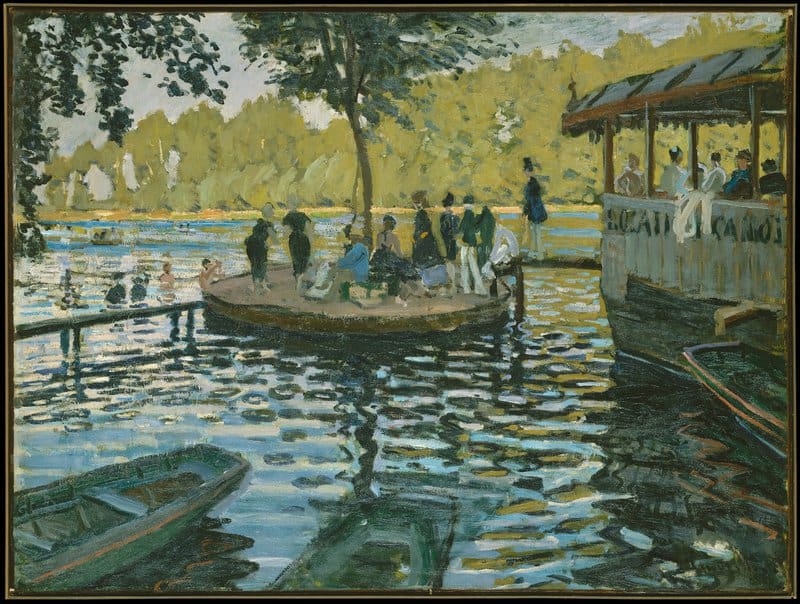
Museum-quality hand-painted artwork Claude Monet La Grenouillere aka Bathers at La Grenouillère
Museum-quality replicas by Paolo: Exceptional product, accurate to the tiniest details, textures and values. Requires skills and time to process, but gives astonishing results. A true work of art for the real connoisseurs.
Buy Claude Monet La Grenouillere aka Bathers at La Grenouillère museum quality
This image is one of the most significant "sketches" in art history: "Bathers at La Grenouillère" (1869). It was painted side-by-side with Pierre-Auguste Renoir, marking the exact moment the Impressionist style was born.
La Grenouillère: The Birthplace of the Impressionist Style
Claude Monet’s La Grenouillère (1869) captures a popular floating restaurant and bathing resort on the Seine near Bougival. This painting is a revolutionary departure from traditional art, focusing on the sensory "impression" of a summer day rather than meticulous detail. It is widely considered one of the first true examples of Impressionist painting.
Artistic Analysis & SEO Keywords
-
The "Camembert" Island: The focal point is the small, circular artificial island, nicknamed "the Camembert," where fashionable Parisians gathered.
-
Revolutionary Water Reflections: Monet used bold, choppy, horizontal slabs of color—blues, whites, and blacks—to represent the sunlight dancing on the moving water. This became a foundational technique for the movement.
-
Modern Leisure: The painting documents the rise of middle-class recreation in 19th-century France, featuring swimmers, rowboats, and socialites in contemporary dress.
-
Plein Air Authenticity: Painted entirely outdoors, the work captures the fleeting effects of light through the trees, creating a "shimmering" atmosphere that feels spontaneous and alive.
Historical Significance: Monet vs. Renoir
In the summer of 1869, Monet and Renoir worked at this site simultaneously. While Renoir focused more on the people and their interactions, Monet focused on the optical effects of the water and light. This creative partnership led to the rapid development of the "broken brushstroke" style that defined their careers.