Free and safe Shipping
| Size | Museum Quality Artworks Hand-Painted with oil paint |
|---|---|
| 23.6 x 18 in 60x47 cm |
$ 494.00 Add to Cart |
| 32 x 24 in 80x63 cm |
$ 707.00 Add to Cart
|
| 40 x 31 in 100cm x 79 cm |
$ 994.00 Add to Cart |
| 4 x 3.1 ft or 47 ¼ x 37 in 120cm x 95 cm |
$ 1278.00 Add to Cart |
| 5 x 3.9 ft or 59 x 46 in 150cm x 119 cm |
$ 1750.00 Add to Cart |
| 6.6 x 5.2 ft or 78 ¾ x 62 in 200cm x 158 cm |
$ 2653.00 Add to Cart |
| 8.16 x 6.5 ft or 98 ½ x 77 in 250cm x 198 cm |
$ 3465.00 Add to Cart |
| 9.8 x 7.8 ft 300cm x 237 cm |
$ 4977.00 Add to Cart |
| 13.12 x 10.4 ft 400cm x 317 cm |
$ 8876.00 Add to Cart |
| 16.4 x 13.0 ft 500cm x 396 cm |
$ 13860.00 - 20% off $ 11088.00 Add to Cart |
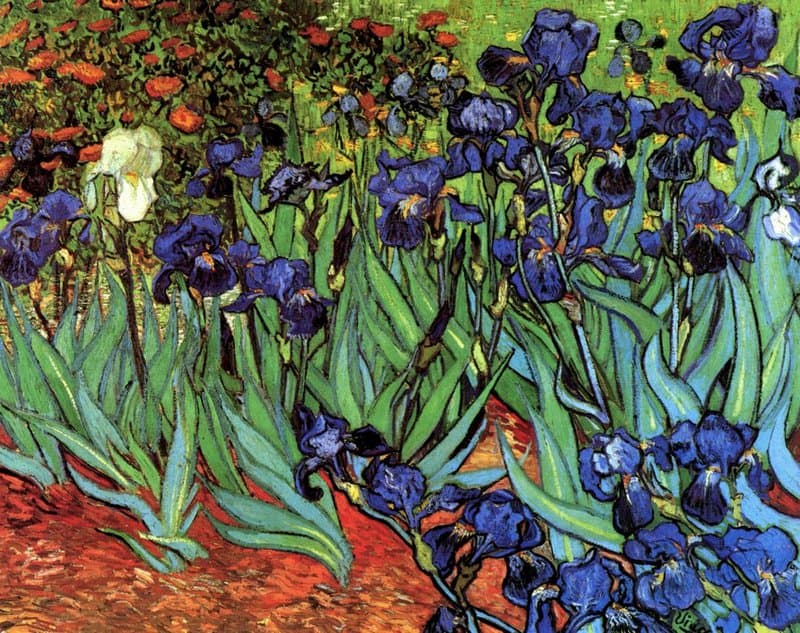
Museum-quality hand-painted artwork Van Gogh, Irises
Museum-quality replicas by Paolo: Exceptional product, accurate to the tiniest details, textures and values. Requires skills and time to process, but gives astonishing results. A true work of art for the real connoisseurs.
Buy Van Gogh, Irises museum quality
One of the most expensive and celebrated floral paintings in the world, "Irises" was painted by Vincent van Gogh in May 1889. Created during his first week at the asylum in Saint-Rémy-de-Provence, Vincent referred to this piece as the "lightning conductor for my illness," believing that his work was his only hope for maintaining his sanity.
-
Title: Irises (Les Iris)
-
Artist: Vincent van Gogh
-
Date: 1889
-
Medium: Oil on canvas
-
Dimensions: 71 cm × 93 cm
-
Location: J. Paul Getty Museum, Los Angeles
-
Historical Note: In 1987, it became the most expensive painting ever sold at the time, fetching $53.9 million.
1. Japanese Influence (Ukiyo-e): Like "Almond Blossom," this work is heavily influenced by Japanese woodblock prints. This is evident in the strong, dark outlines, the unusual "close-up" cropping that cuts off the edges of the flowers, and the lack of a traditional horizon line. This creates an immersive, "carpet-like" effect for the viewer.
2. The Lone White Iris: A focal point of the composition is the single white iris on the left. Art historians often debate its meaning; some see it as a symbol of the artist himself—an isolated, unique figure standing apart from the "crowd" of blue flowers. Others suggest it represents a glimmer of hope amidst his mental struggles.
3. Color and Texture:
-
The Palette: Van Gogh uses a vibrant trio of violet-blue, vivid green, and earthy orange-red for the soil.
-
Lost Colors: Scientific analysis has shown that the irises were originally a much warmer purple. Over time, the light-sensitive red pigment (geranium lake) has faded, leaving them the deep blue we see today.
-
The Soil: The bottom left features thick, expressive strokes of red-orange earth, providing a warm, grounded base for the cool-toned flowers.
4. A Study, Not a Masterpiece (in his eyes): Interestingly, Van Gogh considered this to be a "study" rather than a finished "work." However, his brother Theo recognized its genius immediately and submitted it to the Salon des Indépendants in September 1889, where it received high praise.