Free and safe Shipping
| Size | Museum Quality Artworks Hand-Painted with oil paint |
|---|---|
| 23.6 x 18 in 60x47 cm |
$ 494.00 Add to Cart |
| 32 x 24 in 80x63 cm |
$ 707.00 Add to Cart
|
| 40 x 31 in 100cm x 79 cm |
$ 994.00 Add to Cart |
| 4 x 3.1 ft or 47 ¼ x 37 in 120cm x 95 cm |
$ 1278.00 Add to Cart |
| 5 x 3.9 ft or 59 x 46 in 150cm x 119 cm |
$ 1750.00 Add to Cart |
| 6.6 x 5.2 ft or 78 ¾ x 62 in 200cm x 158 cm |
$ 2653.00 Add to Cart |
| 8.16 x 6.5 ft or 98 ½ x 77 in 250cm x 198 cm |
$ 3465.00 Add to Cart |
| 9.8 x 7.8 ft 300cm x 237 cm |
$ 4977.00 Add to Cart |
| 13.12 x 10.4 ft 400cm x 317 cm |
$ 8876.00 Add to Cart |
| 16.4 x 13.0 ft 500cm x 396 cm |
$ 13860.00 - 20% off $ 11088.00 Add to Cart |
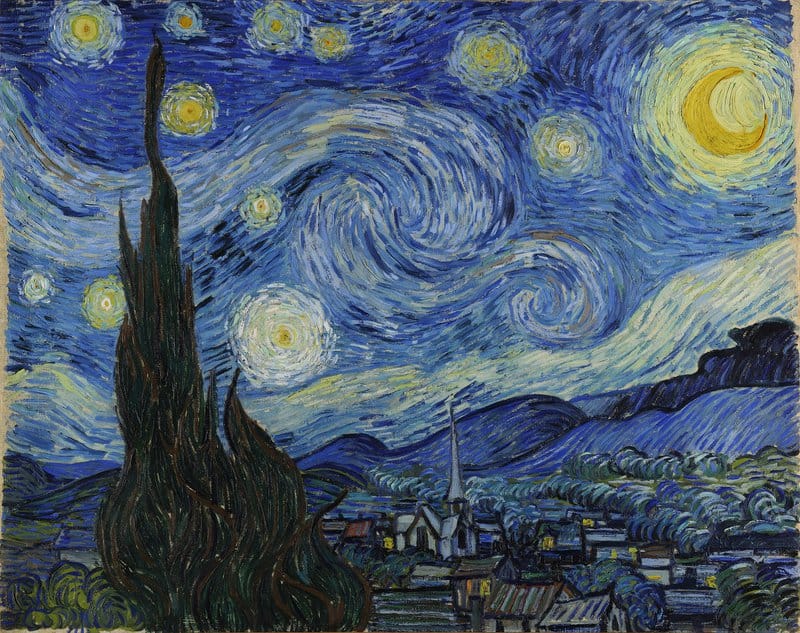
Museum-quality hand-painted artwork Van Gogh, The Starry Night
Museum-quality replicas by Paolo: Exceptional product, accurate to the tiniest details, textures and values. Requires skills and time to process, but gives astonishing results. A true work of art for the real connoisseurs.
Buy Van Gogh, The Starry Night museum quality
Arguably the most famous painting in Western art, "The Starry Night" was painted by Vincent van Gogh in June 1889. Created during his stay at the Saint-Paul-de-Mausole asylum in Saint-Rémy-de-Provence, the work is a profound expression of the artist's turbulent emotions and his spiritual connection to the cosmos.
-
Title: The Starry Night (La Nuit étoilée)
-
Artist: Vincent van Gogh (1853–1890)
-
Date: June 1889
-
Medium: Oil on canvas
-
Dimensions: 73.7 cm × 92.1 cm
1. The Swirling Sky and Turbulence: The defining feature of the painting is the sky, filled with vortex-like spirals and rolling clouds. While often seen as a reflection of Van Gogh's mental instability, physicists have noted that these patterns accurately mimic the mathematical structure of turbulent flow in fluid dynamics. This suggests that Van Gogh was capturing a deep, underlying energy in nature that most people overlook.
2. Key Symbols:
-
The Cypress Tree: The dark, flame-like structure in the foreground is a cypress. In the 19th century, cypresses were symbols of mourning and death. By reaching from the bottom of the canvas to the top, it acts as a bridge between the earth and the sky (or life and the afterlife).
-
The Village of Saint-Rémy: The quiet town at the bottom is largely fictional—Van Gogh couldn't actually see the town from his window in this detail. The tall church spire is reminiscent of the architecture in his native Netherlands, adding a touch of nostalgic "home" to the French landscape.
-
The Morning Star: The brightest white "star" just to the right of the cypress is actually the planet Venus, which was visible in the east during the spring of 1889.
3. Color Theory and Technique:
-
Complementary Contrast: Van Gogh masterfully uses the contrast between the deep ultramarine and cobalt blues of the night and the vibrant yellows and oranges of the moon and stars. This makes the celestial bodies appear to "pulse" with light.
-
Impasto Brushwork: The thick, short, and rhythmic strokes create a sense of frantic movement. The paint is so thick that it creates physical shadows on the canvas, giving the work a three-dimensional quality.
4. Historical Context: Van Gogh painted this from memory during the day, based on the view from his east-facing iron-barred window at the asylum. Ironically, he considered this painting a "failure" and felt that the stars were too large. History, of course, disagreed, and it has since become the definitive image of Post-Impressionism.