Free and safe Shipping
| Size | Museum Quality Artworks Hand-Painted with oil paint |
|---|---|
| 23.6 x 21 in 60x55 cm |
$ 578.00 Add to Cart |
| 32 x 29 in 80x74 cm |
$ 830.00 Add to Cart
|
| 40 x 36 in 100cm x 92 cm |
$ 1159.00 Add to Cart |
| 4 x 3.6 ft or 47 ¼ x 43 in 120cm x 111 cm |
$ 1491.00 Add to Cart |
| 5 x 4.6 ft or 59 x 54 in 150cm x 139 cm |
$ 2044.00 Add to Cart |
| 6.6 x 6.1 ft or 78 ¾ x 72 in 200cm x 185 cm |
$ 3108.00 Add to Cart |
| 8.16 x 7.6 ft or 98 ½ x 90 in 250cm x 231 cm |
$ 4043.00 Add to Cart |
| 9.8 x 9.1 ft 300cm x 277 cm |
$ 5817.00 Add to Cart |
| 13.12 x 12.1 ft 400cm x 370 cm |
$ 10360.00 Add to Cart |
| 16.4 x 15.2 ft 500cm x 462 cm |
$ 16170.00 - 20% off $ 12936.00 Add to Cart |
Museum-quality hand-painted artwork Van Gogh, Pollard Willows at Sunset
Museum-quality replicas by Paolo: Exceptional product, accurate to the tiniest details, textures and values. Requires skills and time to process, but gives astonishing results. A true work of art for the real connoisseurs.
Buy Van Gogh, Pollard Willows at Sunset museum quality
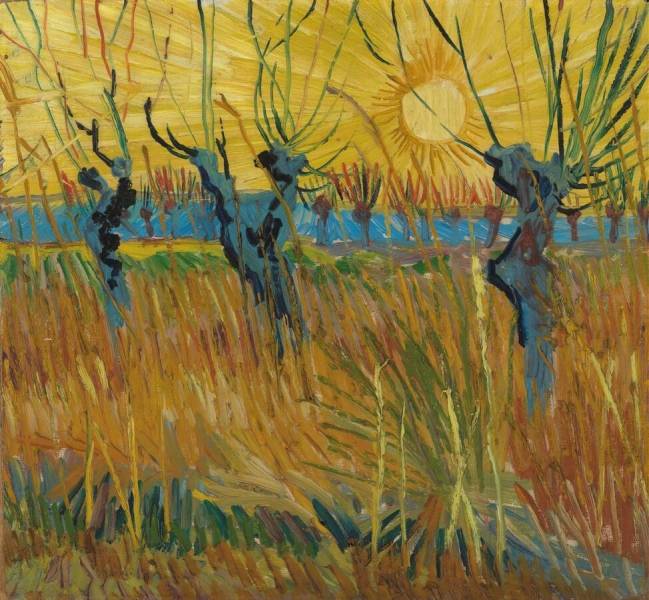
This powerful and intensely colored work, titled "Pollard Willows at Sunset" (or simply Willows at Sunset), was painted by Vincent van Gogh in March 1888. Created shortly after his arrival in Arles, it captures the raw energy of the Provençal sun and marks the beginning of his most famous period of artistic production.
-
Title: Pollard Willows at Sunset (Saules têtards au coucher du soleil)
-
Artist: Vincent van Gogh (1853–1890)
-
Date: March 1888
-
Medium: Oil on canvas mounted on cardboard
-
Dimensions: 31.5 cm x 34.5 cm
1. The "Haloed" Sun: The dominant feature of this painting is the massive, glowing sun. Van Gogh uses thick, radiating lines to create a "halo" effect, making the light feel physical and vibrating. This technique would become a signature of his later masterpieces, like The Sower or The Starry Night, representing nature as a divine, pulsing force.
2. Gnarled Pollard Willows: The trees are "pollarded"—a pruning technique where the upper branches are removed to promote a dense head of foliage. To Van Gogh, these gnarled, twisted forms were deeply expressive.
-
The Trunks: Painted in cool, dark blues and blacks, they provide a stark silhouette against the fiery sky.
-
The Branches: The thin, vertical orange branches reaching upward mimic the rays of the sun, creating a rhythmic unity across the canvas.
3. Color Theory and Emotional Intensity:
-
Complementary Contrast: The painting relies heavily on the tension between orange/yellow (the sky and field) and blue/purple (the tree trunks and distant horizon). This makes the colors appear more luminous and intense.
-
The Field: The foreground is rendered with bold, vertical strokes in shades of rust, orange, and green, suggesting the dry, scrubby landscape of early spring in Arles.
4. Transition from Dutch to Provençal Style: While the subject of willows is common in Dutch art, the execution here is entirely new. You can see Van Gogh shedding the gray, muted light of the North and fully embracing the "high yellow" note of the South. The work is small, but its impasto (thick paint) and aggressive brushwork give it a monumental feel.