Free and safe Shipping
| Size | Museum Quality Artworks Hand-Painted with oil paint |
|---|---|
| 23.6 x 16 in 60x43 cm |
$ 452.00 Add to Cart |
| 32 x 22 in 80x57 cm |
$ 637.00 Add to Cart
|
| 40 x 27 in 100cm x 71 cm |
$ 896.00 Add to Cart |
| 4 x 2.8 ft or 47 ¼ x 33 in 120cm x 85 cm |
$ 1141.00 Add to Cart |
| 5 x 3.5 ft or 59 x 41 in 150cm x 106 cm |
$ 1558.00 Add to Cart |
| 6.6 x 4.7 ft or 78 ¾ x 55 in 200cm x 142 cm |
$ 2387.00 Add to Cart |
| 8.16 x 5.8 ft or 98 ½ x 69 in 250cm x 177 cm |
$ 3098.00 Add to Cart |
| 9.8 x 7.0 ft 300cm x 213 cm |
$ 4473.00 Add to Cart |
| 13.12 x 9.3 ft 400cm x 284 cm |
$ 7952.00 Add to Cart |
| 16.4 x 11.6 ft 500cm x 354 cm |
$ 12390.00 - 20% off $ 9912.00 Add to Cart |
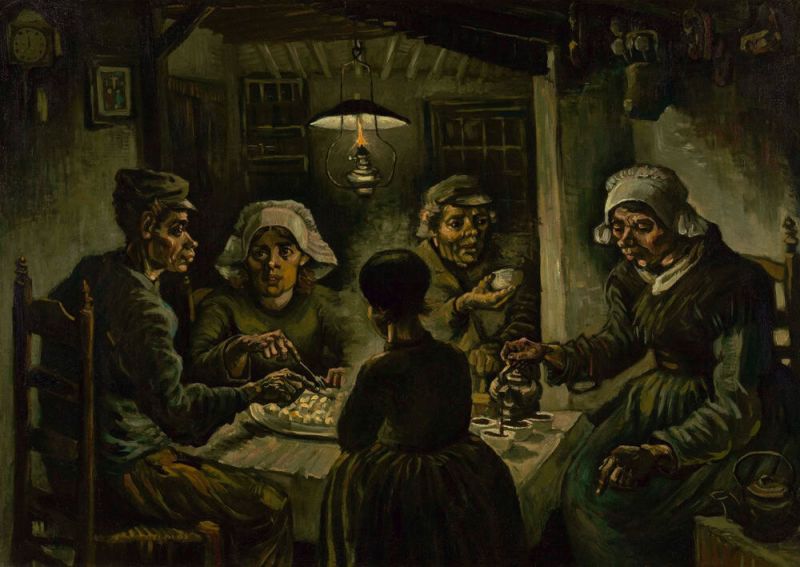
Museum-quality hand-painted artwork Van Gogh, The Potato Eaters (De Aardappeleters)
Museum-quality replicas by Paolo: Exceptional product, accurate to the tiniest details, textures and values. Requires skills and time to process, but gives astonishing results. A true work of art for the real connoisseurs.
Buy Van Gogh, The Potato Eaters (De Aardappeleters) museum quality
Widely considered to be Vincent van Gogh’s first major masterpiece, "The Potato Eaters" (De Aardappeleters) was painted in April 1885 in Nuenen, Netherlands. It represents the pinnacle of his Dutch period and his deep commitment to portraying the raw, unvarnished reality of peasant life.
-
Title: The Potato Eaters (De Aardappeleters)
-
Artist: Vincent van Gogh
-
Date: April 1885
-
Medium: Oil on canvas
-
Dimensions: 82 cm × 114 cm
-
Location: Van Gogh Museum, Amsterdam
1. Social Realism and Honesty: Van Gogh wanted to depict peasants as they truly were. He famously wrote to his brother Theo that he wanted to show that these people, eating their potatoes by the light of their little lamp, had "tilled the earth themselves with these very hands they are putting in the dish." He deliberately chose "ugly" and "coarse" models to emphasize their manual labor and connection to the soil.
2. The Dark Palette: Unlike the brilliant colors of his later French works, this painting is dominated by dark, earthy tones—ochre, bistre, and deep greens. Van Gogh compared the colors of the peasants' faces to "the color of a very dusty potato, unpeeled of course." This use of chiaroscuro (strong contrast between light and dark) centers on the single oil lamp, which creates a somber, intimate atmosphere.
3. Composition and Detail:
-
The Shared Meal: The circular arrangement of the five figures around the table emphasizes a sense of communal bond and shared survival.
-
Hands and Faces: The bony, exaggerated features of the hands and faces are meant to convey a lifetime of physical toil.
-
The Setting: The cramped, dim cottage interior highlights the poverty of the De Groot-van Rooij family, the local farmers who served as his models.
4. Historical Significance: At the time, the painting was criticized by his friend and fellow artist Anthon van Rappard for its technical "errors" in anatomy. However, for Vincent, the emotional truth was more important than academic perfection. He remained proud of this work throughout his life, even as his style evolved into the bright Impressionism of his later years.