Free and safe Shipping
| Size | Museum Quality Artworks Hand-Painted with oil paint |
|---|---|
| 23.6 x 17 in 60x45 cm |
$ 473.00 Add to Cart |
| 32 x 23 in 80x60 cm |
$ 672.00 Add to Cart
|
| 40 x 29 in 100cm x 76 cm |
$ 959.00 Add to Cart |
| 4 x 3.0 ft or 47 ¼ x 35 in 120cm x 91 cm |
$ 1222.00 Add to Cart |
| 5 x 3.7 ft or 59 x 44 in 150cm x 113 cm |
$ 1663.00 Add to Cart |
| 6.6 x 5.0 ft or 78 ¾ x 59 in 200cm x 151 cm |
$ 2538.00 Add to Cart |
| 8.16 x 6.2 ft or 98 ½ x 74 in 250cm x 189 cm |
$ 3308.00 Add to Cart |
| 9.8 x 7.4 ft 300cm x 227 cm |
$ 4767.00 Add to Cart |
| 13.12 x 9.9 ft 400cm x 302 cm |
$ 8456.00 Add to Cart |
| 16.4 x 12.4 ft 500cm x 378 cm |
$ 13230.00 - 20% off $ 10584.00 Add to Cart |
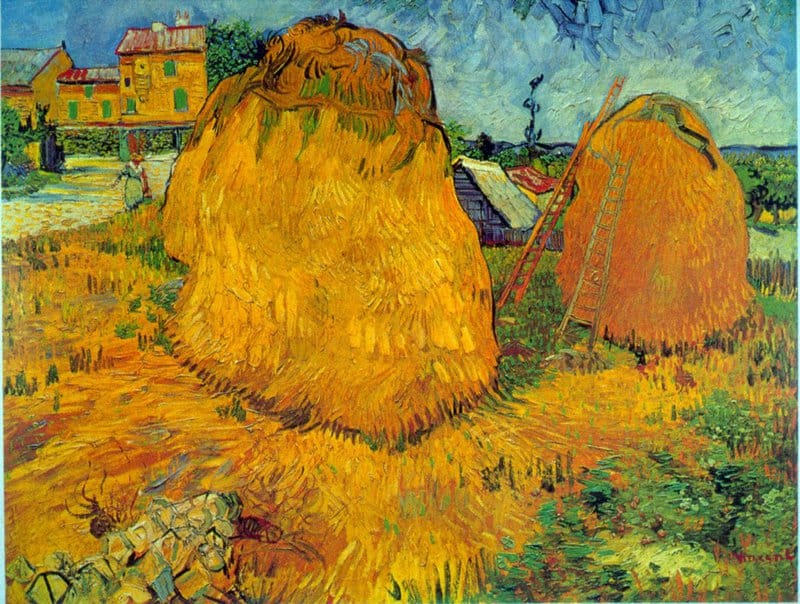
Museum-quality hand-painted artwork Van Gogh, Haystacks in Provence
Museum-quality replicas by Paolo: Exceptional product, accurate to the tiniest details, textures and values. Requires skills and time to process, but gives astonishing results. A true work of art for the real connoisseurs.
Buy Van Gogh, Haystacks in Provence museum quality
This sun-drenched pastoral scene, titled "Haystacks in Provence" (also known as Wheat Stacks with Reaper or Haystacks near a Farm in Provence), was painted by Vincent van Gogh in June 1888. This work is a quintessential example of his Arles period, where he was captivated by the golden light and agricultural rhythms of southern France.
-
Title: Haystacks in Provence (Les Meules en Provence)
-
Artist: Vincent van Gogh
-
Date: June 1888 (Arles Period)
-
Medium: Oil on canvas
-
Dimensions: 73 cm x 92.5 cm
1. Mastery of the Golden Hour: During June 1888, Van Gogh was obsessed with capturing the harvest. In this painting, he uses a range of yellows, golds, and ochres to convey the searing heat of the Provencal sun. To prevent the yellow from becoming flat, he contrasts it with a vibrant cerulean blue sky and deep green accents in the foreground.
2. Geometric Composition:
-
Massive Forms: The two large haystacks dominate the center, acting almost like architectural monuments.
-
The Ladders: The leaning ladders provide sharp diagonal lines that lead the eye upward and add a sense of human scale and labor to the landscape.
-
Framing: In the upper left, the farmhouse with its red roof and green shutters provides a solid, stabilizing anchor to the swirling textures of the hay and sky.
3. Signature Brushwork: The field in the foreground is rendered with thick, multidirectional strokes—a technique known as impasto. This gives the "ground" a tangible, prickly texture that mimics the look of harvested stubble. The sky, by contrast, is painted with broader, more fluid strokes that suggest a high, windy atmosphere.
4. Social Commentary: Like his hero Jean-François Millet, Van Gogh saw a divine quality in manual labor. The haystacks aren't just farm produce; they are symbols of the fruitfulness of the earth and the hard work of the peasantry. He viewed these rural scenes as "modern icons."