Free and safe Shipping
| Size | Museum Quality Artworks Hand-Painted with oil paint |
|---|---|
| 23.6 x 20 in 60x51 cm |
$ 536.00 Add to Cart |
| 32 x 26 in 80x68 cm |
$ 763.00 Add to Cart
|
| 40 x 33 in 100cm x 85 cm |
$ 1071.00 Add to Cart |
| 4 x 3.3 ft or 47 ¼ x 40 in 120cm x 102 cm |
$ 1372.00 Add to Cart |
| 5 x 4.2 ft or 59 x 50 in 150cm x 127 cm |
$ 1866.00 Add to Cart |
| 6.6 x 5.6 ft or 78 ¾ x 66 in 200cm x 170 cm |
$ 2856.00 Add to Cart |
| 8.16 x 7.0 ft or 98 ½ x 83 in 250cm x 212 cm |
$ 3710.00 Add to Cart |
| 9.8 x 8.3 ft 300cm x 254 cm |
$ 5334.00 Add to Cart |
| 13.12 x 11.1 ft 400cm x 339 cm |
$ 9492.00 Add to Cart |
| 16.4 x 13.9 ft 500cm x 424 cm |
$ 14840.00 - 20% off $ 11872.00 Add to Cart |
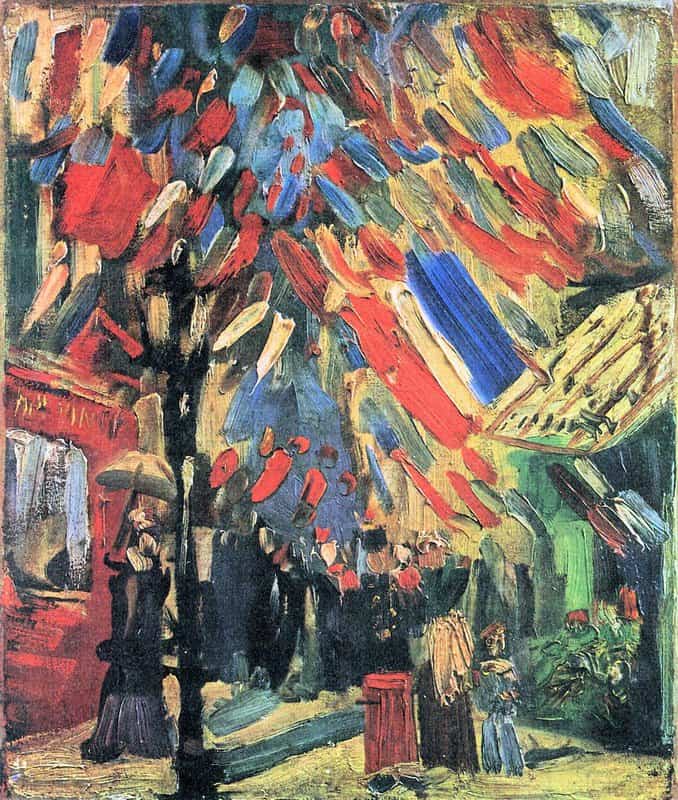
Museum-quality hand-painted artwork Van Gogh, The Fourteenth of July Celebration in Paris (Le 14 Juillet)
Museum-quality replicas by Paolo: Exceptional product, accurate to the tiniest details, textures and values. Requires skills and time to process, but gives astonishing results. A true work of art for the real connoisseurs.
Buy Van Gogh, The Fourteenth of July Celebration in Paris (Le 14 Juillet) museum quality
This vibrant painting, titled "The Fourteenth of July Celebration in Paris" (or simply Le Quatorze Juillet), was created by Vincent van Gogh in the summer of 1886.
It captures the festive atmosphere of Bastille Day (France’s national holiday) in Paris, shortly after Van Gogh moved there to live with his brother Theo. This period marked a massive turning point in his style, as he moved away from the dark, somber tones of his Dutch period and embraced the bright, energetic palettes of Impressionism and Pointillism.
-
Title: The Fourteenth of July Celebration in Paris (also known as The 14th of July in Paris)
-
Artist: Vincent van Gogh (1853–1890)
-
Date: 1886
-
Medium: Oil on canvas
-
Dimensions: 44 cm x 39 cm
-
Location: Private Collection (Catalogue: F 222, JH 1108)
1. Style and Technique: The painting is a masterclass in short, rhythmic brushstrokes. Van Gogh uses a proto-Expressionist approach where the paint is applied thickly (impasto), giving the canvas a physical texture that mimics the "noise" and movement of a crowded street.
2. Color Palette: Dominating the scene are the tricolor (red, white, and blue) flags of France. The use of primary colors creates a sense of high energy. You can see how Van Gogh is experimenting with complementary colors—placing vibrant reds against greens and yellows—to make the scene "pop."
3. Composition and Meaning:
-
Festivity vs. Chaos: While the subject is a celebration, the brushwork is almost aggressive. Some art historians suggest this reflects Van Gogh’s perspective as an "outsider" in Paris—observing the nationalistic fervor with a mix of fascination and overwhelm.
-
Subject Matter: It depicts a street scene likely in Montmartre, decorated with flags and bunting. The figures at the bottom are blurred and indistinct, focusing the viewer's attention on the upward-reaching colors and the overall mood rather than individual people.