Free and safe Shipping
| Size | Museum Quality Artworks Hand-Painted with oil paint |
|---|---|
| 23.6 x 17 in 60x45 cm |
$ 473.00 Add to Cart |
| 32 x 23 in 80x60 cm |
$ 672.00 Add to Cart
|
| 40 x 29 in 100cm x 75 cm |
$ 945.00 Add to Cart |
| 4 x 2.9 ft or 47 ¼ x 35 in 120cm x 89 cm |
$ 1197.00 Add to Cart |
| 5 x 3.7 ft or 59 x 44 in 150cm x 112 cm |
$ 1645.00 Add to Cart |
| 6.6 x 4.9 ft or 78 ¾ x 58 in 200cm x 149 cm |
$ 2503.00 Add to Cart |
| 8.16 x 6.1 ft or 98 ½ x 73 in 250cm x 186 cm |
$ 3255.00 Add to Cart |
| 9.8 x 7.3 ft 300cm x 224 cm |
$ 4704.00 Add to Cart |
| 13.12 x 9.8 ft 400cm x 298 cm |
$ 8344.00 Add to Cart |
| 16.4 x 12.2 ft 500cm x 373 cm |
$ 13055.00 - 20% off $ 10444.00 Add to Cart |
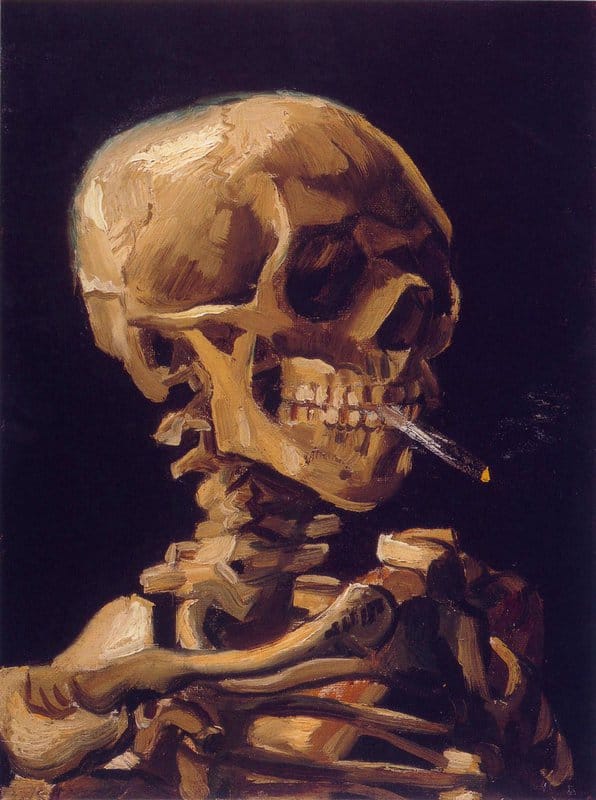
Museum-quality hand-painted artwork Van Gogh, Skull of a Skeleton with Burning Cigarette
Museum-quality replicas by Paolo: Exceptional product, accurate to the tiniest details, textures and values. Requires skills and time to process, but gives astonishing results. A true work of art for the real connoisseurs.
Buy Van Gogh, Skull of a Skeleton with Burning Cigarette museum quality
One of Vincent van Gogh’s most unusual and rebellious works, "Skull of a Skeleton with Burning Cigarette" was painted in early 1886. Created while he was attending the Royal Academy of Fine Arts in Antwerp, it stands out as a humorous, macabre, and slightly defiant departure from his more traditional studies.
-
Title: Skull of a Skeleton with Burning Cigarette (Kop van een skelet met brandende sigaret)
-
Artist: Vincent van Gogh
-
Date: Winter 1885–1886
-
Medium: Oil on canvas
-
Dimensions: 32 cm × 24.5 cm
-
Location: Van Gogh Museum, Amsterdam
1. A Juvenile Joke or Serious Satire? At the Antwerp Academy, drawing skeletons was a standard, often boring requirement for anatomy class. This painting is widely interpreted as a satirical jab at the rigid academic style of the time. By adding the cigarette, Van Gogh breathed a "living" habit into a symbol of death, showcasing his early wit and dissatisfaction with traditional art education.
2. The Vanitas Tradition: While it looks like a modern "edgy" poster, the work is rooted in the 17th-century Dutch tradition of Memento Mori and Vanitas paintings—artworks intended to remind the viewer of the shortness of life. However, Van Gogh’s version feels more like a "darkly humorous self-portrait" of his own health struggles and heavy smoking habits at the time.
3. Technique and Color:
-
The Palette: The work uses the somber, monochromatic tones of his Dutch period—browns, ochres, and blacks.
-
The Glow: The tiny, bright tip of the burning cigarette provides the only "warmth" and focal point in the dark composition, a brilliant use of a single point of light to create depth.
-
Brushwork: Despite being a student work, the brushstrokes are bold and vigorous, particularly in the structure of the skull and the wispy, delicate trail of smoke.
4. Health Context: When Vincent painted this, he was in poor health, suffering from stomach ailments and dental problems caused by overwork and a diet of mostly bread, coffee, and tobacco. Some historians see this as a reflection of his own physical exhaustion.