Free and safe Shipping
| Size | Museum Quality Artworks Hand-Painted with oil paint |
|---|---|
| 23.6 x 16 in 60x43 cm |
$ 574.00 Add to Cart |
| 32 x 22 in 80x57 cm |
$ 637.00 Add to Cart
|
| 40 x 27 in 100cm x 71 cm |
$ 896.00 Add to Cart |
| 4 x 2.8 ft or 47 ¼ x 33 in 120cm x 85 cm |
$ 1141.00 Add to Cart |
| 5 x 3.5 ft or 59 x 41 in 150cm x 106 cm |
$ 1558.00 Add to Cart |
| 6.6 x 4.7 ft or 78 ¾ x 55 in 200cm x 142 cm |
$ 2387.00 Add to Cart |
| 8.16 x 5.8 ft or 98 ½ x 69 in 250cm x 177 cm |
$ 3098.00 Add to Cart |
| 9.8 x 7.0 ft 300cm x 213 cm |
$ 4473.00 Add to Cart |
| 13.12 x 9.3 ft 400cm x 284 cm |
$ 7952.00 Add to Cart |
| 16.4 x 11.6 ft 500cm x 354 cm |
$ 12390.00 - 20% off $ 9912.00 Add to Cart |
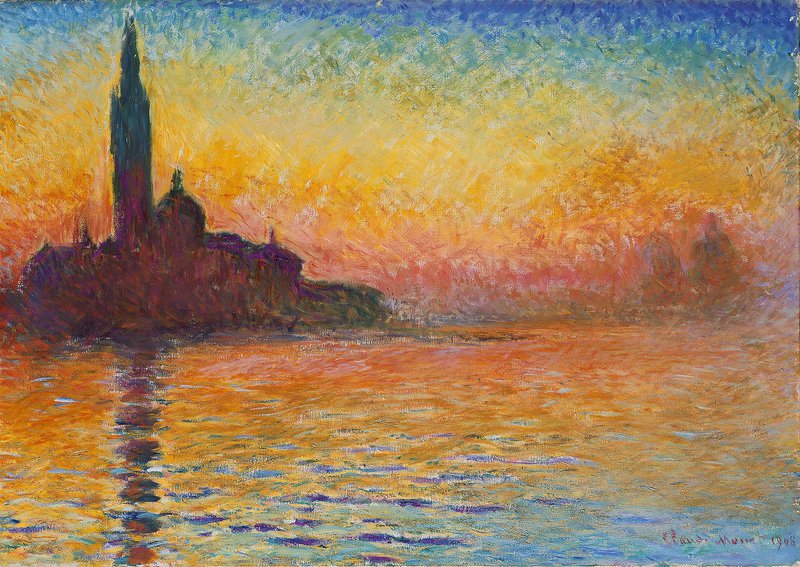
Museum-quality hand-painted artwork Claude Monet, San Giorgio Maggiore At Dusk - Saint-Georges Majeur au Crépuscule
Museum-quality replicas by Paolo: Exceptional product, accurate to the tiniest details, textures and values. Requires skills and time to process, but gives astonishing results. A true work of art for the real connoisseurs.
Buy Claude Monet, San Giorgio Maggiore At Dusk - Saint-Georges Majeur au Crépuscule museum quality
San Giorgio Maggiore at Dusk: Monet’s Venetian Sunset Masterpiece
Claude Monet’s San Giorgio Maggiore at Dusk (1908) is a spectacular exploration of light and atmosphere. During his ten-week stay in Venice, Monet became enchanted by the unique way the sun set over the Adriatic, reflecting off the lagoon's waters. This work captures the silhouette of the monastery island of San Giorgio Maggiore, transformed into a dark, ethereal shape against a sky that seems to be literally on fire.
Artistic Analysis & Visual Style
-
Explosive Color Palette: Monet utilizes a daring range of cadmium yellows, burnt oranges, and deep magentas. These warm tones are brilliantly contrasted by the cool cobalt blues and indigoes of the water and the upper sky.
-
The "Radiant" Technique: The sky is rendered with short, multidirectional brushstrokes that create a shimmering, pulsating effect, capturing the movement of light particles through the evening haze.
-
Structural Silhouettes: The Campanile (bell tower) and the dome of the church are reduced to dark, simplified forms. By de-emphasizing architectural detail, Monet forces the viewer to focus entirely on the sensory experience of color.
-
Lagoon Reflections: The water in the foreground acts as a mirror, with vertical streaks of orange and blue that break up the surface and create a sense of gentle movement in the Venetian lagoon.
Historical Significance: Monet in Venice
At age 68, Monet was initially hesitant to visit Venice, fearing it had been "painted too much" by other artists. However, he soon found that the city’s unique moisture and light provided a new "envelope" for his Impressionist theories. This 1908 series is seen as a transition toward his final, more abstract Water Lilies, as he moved further away from realism and deeper into chromatic expression.