Free and safe Shipping
| Size | Museum Quality Artworks Hand-Painted with oil paint |
|---|---|
| 23.6 x 18 in 60x47 cm |
$ 494.00 Add to Cart |
| 32 x 24 in 80x63 cm |
$ 707.00 Add to Cart
|
| 40 x 31 in 100cm x 79 cm |
$ 994.00 Add to Cart |
| 4 x 3.1 ft or 47 ¼ x 37 in 120cm x 95 cm |
$ 1278.00 Add to Cart |
| 5 x 3.9 ft or 59 x 46 in 150cm x 118 cm |
$ 1736.00 Add to Cart |
| 6.6 x 5.2 ft or 78 ¾ x 62 in 200cm x 158 cm |
$ 2653.00 Add to Cart |
| 8.16 x 6.5 ft or 98 ½ x 77 in 250cm x 197 cm |
$ 3448.00 Add to Cart |
| 9.8 x 7.8 ft 300cm x 237 cm |
$ 4977.00 Add to Cart |
| 13.12 x 10.4 ft 400cm x 316 cm |
$ 8848.00 Add to Cart |
| 16.4 x 12.9 ft 500cm x 394 cm |
$ 13790.00 - 20% off $ 11032.00 Add to Cart |
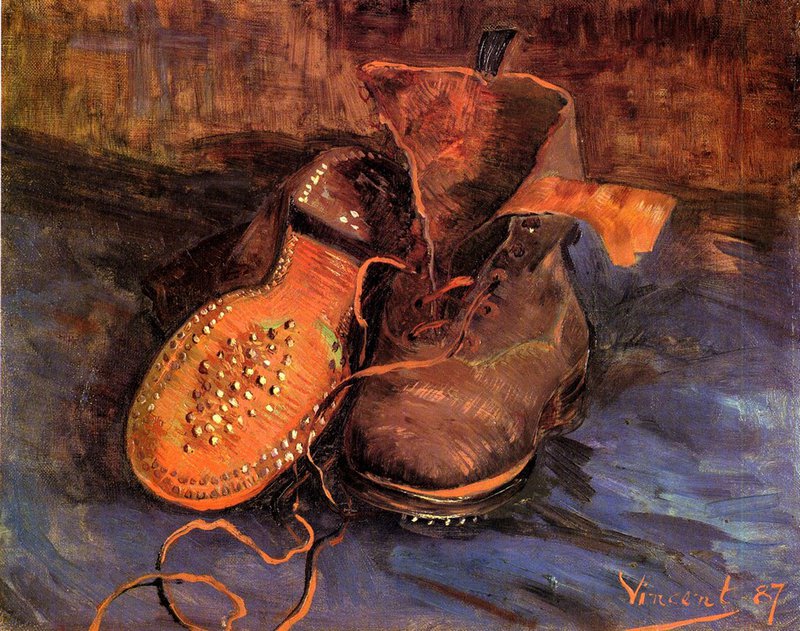
Museum-quality hand-painted artwork Van Gogh, A Pair of Shoes (Une paire de chaussures)
Museum-quality replicas by Paolo: Exceptional product, accurate to the tiniest details, textures and values. Requires skills and time to process, but gives astonishing results. A true work of art for the real connoisseurs.
Buy Van Gogh, A Pair of Shoes (Une paire de chaussures) museum quality
This striking still life, titled "A Pair of Shoes" (or Old Shoes with Laces), was painted by Vincent van Gogh in 1887 during his stay in Paris. While a pair of worn-out boots might seem like an odd subject, it is one of Van Gogh’s most famous explorations of the dignity found in hard work and the "poetry" of everyday objects.
-
Title: A Pair of Shoes (Une paire de chaussures)
-
Artist: Vincent van Gogh
-
Date: 1887
-
Medium: Oil on canvas
-
Dimensions: 34 cm x 41.5 cm
-
Location: Baltimore Museum of Art (or Van Gogh Museum, depending on the specific version in the series)
1. Symbolic Meaning: Van Gogh was fascinated by the "lived-in" quality of these boots. To him, they weren't just leather and laces; they represented the toil of the working class and the long walks he took through the city and countryside. There is a sense of "autobiography" in the wear and tear—a reflection of the artist’s own difficult journey.
2. Technique and Color:
-
Complementary Contrast: Notice the interplay between the warm, earthy oranges/browns of the leather and the cool, deep blues of the floor. This was a hallmark of his Paris period, influenced by his study of color theory.
-
The Sole: One boot is upturned, showing the hobnails in the sole. This adds a unique geometric texture to the piece and emphasizes the heavy use the shoes have endured.
-
Brushwork: The strokes are thick and expressive, particularly in the untied, loopy laces that give the painting a sense of "movement" despite being a still life.
3. Philosophical Legacy: This specific painting became a centerpiece for 20th-century philosophy. Martin Heidegger famously wrote about it to discuss the "truth" of art, arguing that the painting reveals the essence of the "peasant world" and the equipment used within it.