Free and safe Shipping
| Size | Museum Quality Artworks Hand-Painted with oil paint |
|---|---|
| 23.6 x 18 in 60x47 cm |
$ 494.00 Add to Cart |
| 32 x 24 in 80x63 cm |
$ 707.00 Add to Cart
|
| 40 x 31 in 100cm x 79 cm |
$ 994.00 Add to Cart |
| 4 x 3.1 ft or 47 ¼ x 37 in 120cm x 95 cm |
$ 1278.00 Add to Cart |
| 5 x 3.9 ft or 59 x 46 in 150cm x 118 cm |
$ 1736.00 Add to Cart |
| 6.6 x 5.2 ft or 78 ¾ x 62 in 200cm x 158 cm |
$ 2653.00 Add to Cart |
| 8.16 x 6.5 ft or 98 ½ x 77 in 250cm x 197 cm |
$ 3448.00 Add to Cart |
| 9.8 x 7.8 ft 300cm x 237 cm |
$ 4977.00 Add to Cart |
| 13.12 x 10.4 ft 400cm x 316 cm |
$ 8848.00 Add to Cart |
| 16.4 x 12.9 ft 500cm x 394 cm |
$ 13790.00 - 20% off $ 11032.00 Add to Cart |
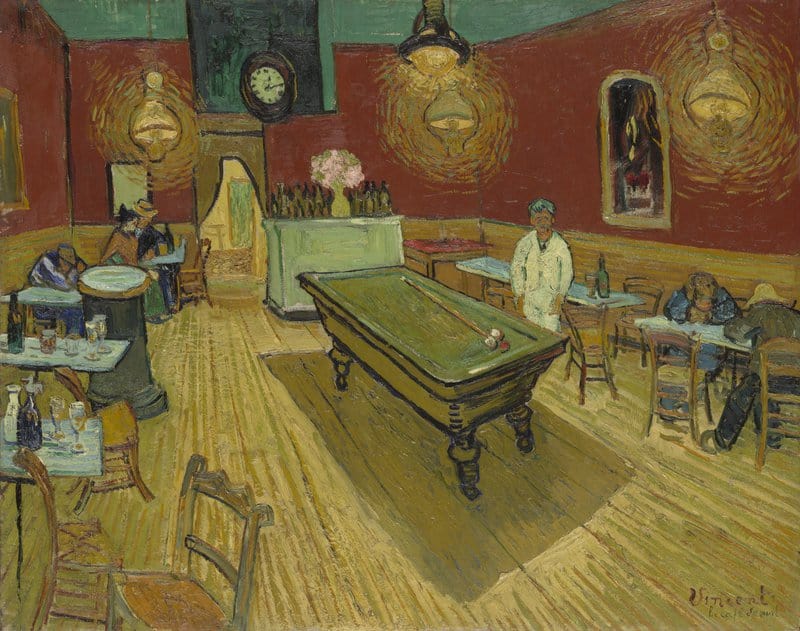
Museum-quality hand-painted artwork Van Gogh, The Night Café
Museum-quality replicas by Paolo: Exceptional product, accurate to the tiniest details, textures and values. Requires skills and time to process, but gives astonishing results. A true work of art for the real connoisseurs.
Buy Van Gogh, The Night Café museum quality
One of Vincent van Gogh’s most psychologically intense works, "The Night Café" (Le Café de nuit) was painted in September 1888 in Arles, France. Unlike many of his other works that seek beauty in nature, this interior was an intentional attempt to capture the "terrible passions of humanity" through clashing colors and a claustrophobic atmosphere.
-
Title: The Night Café (Le Café de nuit)
-
Artist: Vincent van Gogh
-
Date: September 1888 (Arles Period)
-
Medium: Oil on canvas
-
Dimensions: 72.4 cm x 92.1 cm
-
Location: Yale University Art Gallery, New Haven, Connecticut
1. "Ugly" by Design: Van Gogh famously described this painting in letters to his brother Theo as "one of the ugliest I have done." He didn't mean it was poorly painted, but rather that it was designed to provoke a sense of unease. He wanted to depict a place where "one can ruin oneself, go mad, or commit a crime."
2. Emotional Color Theory: The painting is a masterclass in the use of clashing complementary colors.
-
Red and Green: The blood-red walls set against the sickly green of the billiard table and ceiling create a visual tension that feels "vibrating" and uncomfortable.
-
Yellow: The yellow floor and the exaggerated "halos" around the gas lamps add to the dizzying, late-night fever-dream quality of the room.
3. Steep Perspective: The floor is painted with a steep, tilted perspective that seems to slide toward the viewer. The billiard table, placed dead-center, is rendered with exaggerated lines that draw the eye into the empty heart of the room, emphasizing a sense of isolation and loneliness.
4. The Subjects: The café depicted is the Café de la Gare, run by Joseph-Michel Ginoux.
-
The Proprietor: Standing near the billiard table in a white coat, Ginoux looks like a ghostly overseer of the "night prowlers."
-
The Patrons: The figures slumped over tables in the corners represent the lonely, marginalized people who have nowhere else to go in the small hours of the night.
5. Comparison with "The Café Terrace at Night": This painting is the psychological opposite of his Café Terrace at Night. While the terrace is charming, blue, and romantic, The Night Café is internal, oppressive, and jarring.