Free and safe Shipping
| Size | Museum Quality Artworks Hand-Painted with oil paint |
|---|---|
| 23.6 x 14 in 60x37 cm |
$ 389.00 Add to Cart |
| 32 x 19 in 80x49 cm |
$ 550.00 Add to Cart
|
| 40 x 24 in 100cm x 61 cm |
$ 770.00 Add to Cart |
| 4 x 2.4 ft or 47 ¼ x 28 in 120cm x 73 cm |
$ 980.00 Add to Cart |
| 5 x 3.0 ft or 59 x 36 in 150cm x 92 cm |
$ 1351.00 Add to Cart |
| 6.6 x 4.0 ft or 78 ¾ x 48 in 200cm x 122 cm |
$ 2051.00 Add to Cart |
| 8.16 x 5.0 ft or 98 ½ x 60 in 250cm x 153 cm |
$ 2678.00 Add to Cart |
| 9.8 x 6.0 ft 300cm x 184 cm |
$ 3864.00 Add to Cart |
| 13.12 x 8.0 ft 400cm x 245 cm |
$ 6860.00 Add to Cart |
| 16.4 x 10.0 ft 500cm x 306 cm |
$ 10710.00 - 20% off $ 8568.00 Add to Cart |
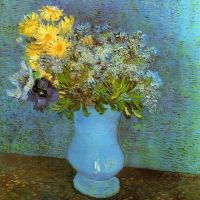
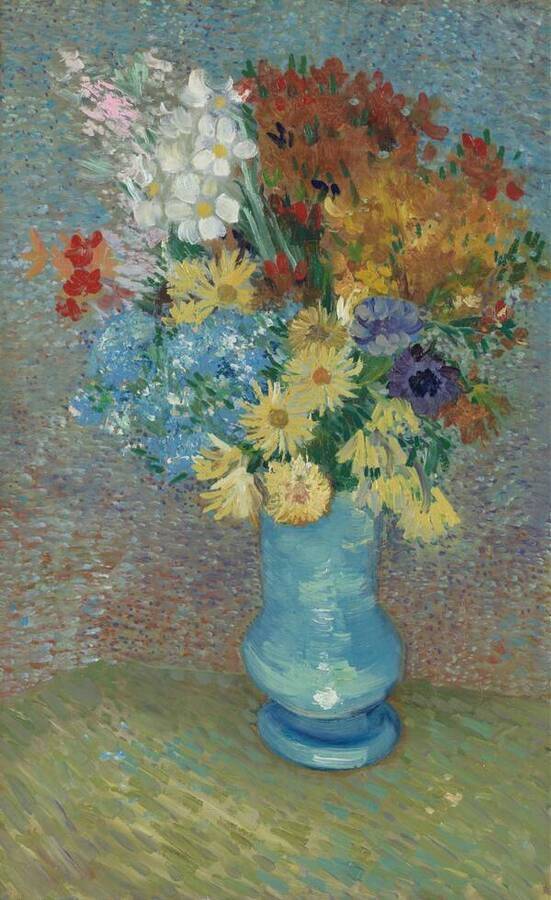
Museum-quality hand-painted artwork Van Gogh, Flowers In A Blue Vase
Museum-quality replicas by Paolo: Exceptional product, accurate to the tiniest details, textures and values. Requires skills and time to process, but gives astonishing results. A true work of art for the real connoisseurs.
Buy Van Gogh, Flowers In A Blue Vase museum quality
This radiant floral study, titled "Flowers in a Blue Vase," was painted by Vincent van Gogh in 1887 during his pivotal two-year stay in Paris. This work serves as a colorful record of the artist's transition from the somber tones of his Dutch period to the light-filled, experimental style of the French avant-garde.
-
Title: Flowers in a Blue Vase (Fleurs dans un vase bleu)
-
Artist: Vincent van Gogh
-
Date: Summer 1887
-
Medium: Oil on canvas
-
Dimensions: 58 cm x 45.5 cm
1. Pointillist Influence: In 1887, Van Gogh was deeply influenced by the Neo-Impressionist circle (specifically Georges Seurat and Paul Signac). In this painting, you can see him experimenting with Pointillism, using small, distinct dabs and dots of color. This is most evident in the background, where the "broken" color creates a shimmering, atmospheric effect that makes the vase pop.
2. A Study in Color Theory: The painting is a deliberate exercise in complementary colors. The bright, sky-blue vase sits against a warm, orangey-brown background, while the yellow daisies and red blossoms create a vibrant visual tension. This period was when Van Gogh truly "found" the bright palette that would define his later masterpieces in Arles.
3. Composition and Subject:
-
The Bouquet: The arrangement is a dense, lively mix of summer flowers, including daisies, anemones, and potentially zinnias.
-
The Vase: The blue vase is a recurring object in his Paris still lifes. It provides a solid, cool anchor for the exploding colors of the petals.
-
The Surface: The table is rendered with long, sweeping brushstrokes that contrast with the delicate dots of the background, showing Van Gogh’s refusal to stick strictly to one "ism."
4. Scientific Discovery: Interestingly, in 2011, researchers used high-energy X-rays to discover that a greyish-yellow crust on some of the flowers was actually a chemical reaction from a protective varnish added later by a restorer. Underneath the crust, the colors were originally even more brilliant, particularly the cadmium yellows.