Free and safe Shipping
| Size | Museum Quality Artworks Hand-Painted with oil paint |
|---|---|
| 23.6 x 18 in 60x47 cm |
$ 494.00 Add to Cart |
| 32 x 24 in 80x62 cm |
$ 693.00 Add to Cart
|
| 40 x 30 in 100cm x 78 cm |
$ 984.00 Add to Cart |
| 4 x 3.1 ft or 47 ¼ x 36 in 120cm x 93 cm |
$ 1250.00 Add to Cart |
| 5 x 3.8 ft or 59 x 45 in 150cm x 116 cm |
$ 1705.00 Add to Cart |
| 6.6 x 5.1 ft or 78 ¾ x 61 in 200cm x 155 cm |
$ 2604.00 Add to Cart |
| 8.16 x 6.4 ft or 98 ½ x 76 in 250cm x 194 cm |
$ 3395.00 Add to Cart |
| 9.8 x 7.6 ft 300cm x 233 cm |
$ 4893.00 Add to Cart |
| 13.12 x 10.2 ft 400cm x 310 cm |
$ 8680.00 Add to Cart |
| 16.4 x 12.7 ft 500cm x 388 cm |
$ 13580.00 - 20% off $ 10864.00 Add to Cart |
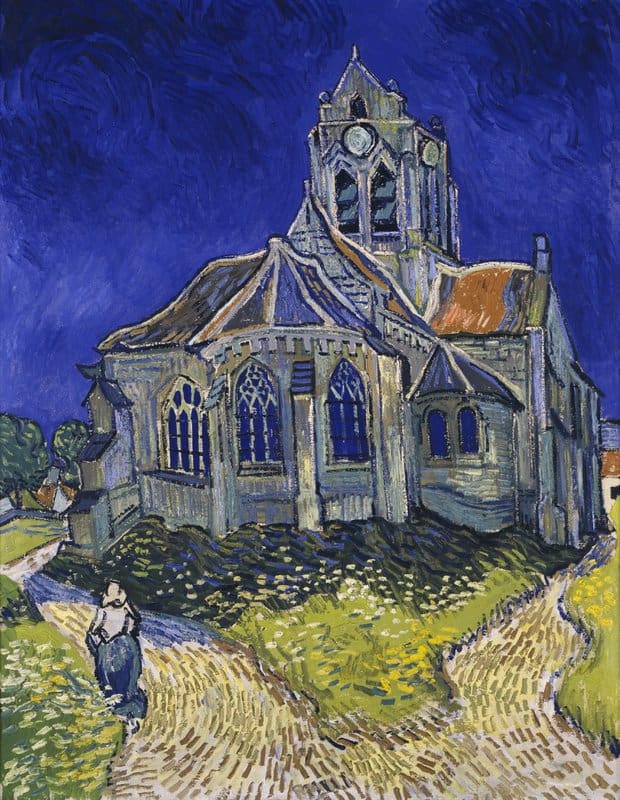
Museum-quality hand-painted artwork Van Gogh, The Church at Auvers
Museum-quality replicas by Paolo: Exceptional product, accurate to the tiniest details, textures and values. Requires skills and time to process, but gives astonishing results. A true work of art for the real connoisseurs.
Buy Van Gogh, The Church at Auvers museum quality
One of the last major works completed by Vincent van Gogh, "The Church at Auvers" was painted in June 1890. Created just weeks before his death, this powerful image of the 13th-century Notre-Dame-de-l'Assomption reflects the artist's move away from traditional realism toward a highly expressive, almost hallucinatory style.
-
Title: The Church at Auvers (L'Église d'Auvers-sur-Oise)
-
Artist: Vincent van Gogh
-
Date: June 1890 (Auvers-sur-Oise Period)
-
Medium: Oil on canvas
-
Dimensions: 94 cm × 74 cm
-
Location: Musée d'Orsay, Paris
1. Architectural Distortion: The church is not rendered with straight, stable lines. Instead, the building appears to heave and undulate, as if it were a living organism. This "wavering" perspective is a hallmark of Van Gogh's final period, suggesting a world where even solid stone is subject to intense spiritual or emotional energy.
2. The Deep Cobalt Sky: The sky is a heavy, saturated cobalt blue, which contrasts sharply with the sun-drenched paths in the foreground. This dark sky creates a sense of foreboding or "noonday darkness," a theme Van Gogh explored in several of his final landscapes.
3. Compositional Paths: Two paths fork in the foreground, framing the church. A lone peasant woman walks along the left path. This "fork in the road" is often interpreted as a symbol of the artist's own internal conflict or the choice between different spiritual or life paths.
4. Color Contrast and Texture:
-
Complementary Colors: The cool blues and purples of the church and sky are balanced by the warm, sunlit yellows and greens of the grass and paths.
-
Impasto: The foreground is a mosaic of thick, short strokes that give the earth a vibrating, tactile quality.
-
Stained Glass: The windows of the church are filled with the same deep blue as the sky, making the building appear "hollowed out" or transparent to the heavens.
5. Spiritual Meaning: Van Gogh had a complicated relationship with organized religion, having failed as a lay preacher in his youth. By painting the church from the back and making it appear unstable, some critics suggest he was expressing his detachment from the institutional church while still acknowledging its monumental presence.